Understanding Relationships
RD 8 Impossible Dreams - A Model-Obstacle Relationship
How impossible ideals can become obstacles that trap us in rivalry.
Source: Nurturing Hope, Understanding Relationships, May 22 Final The Understanding Conflict Trust - Nurturing Hope - 3 Understanding Relationships.pdf, pages 39-43
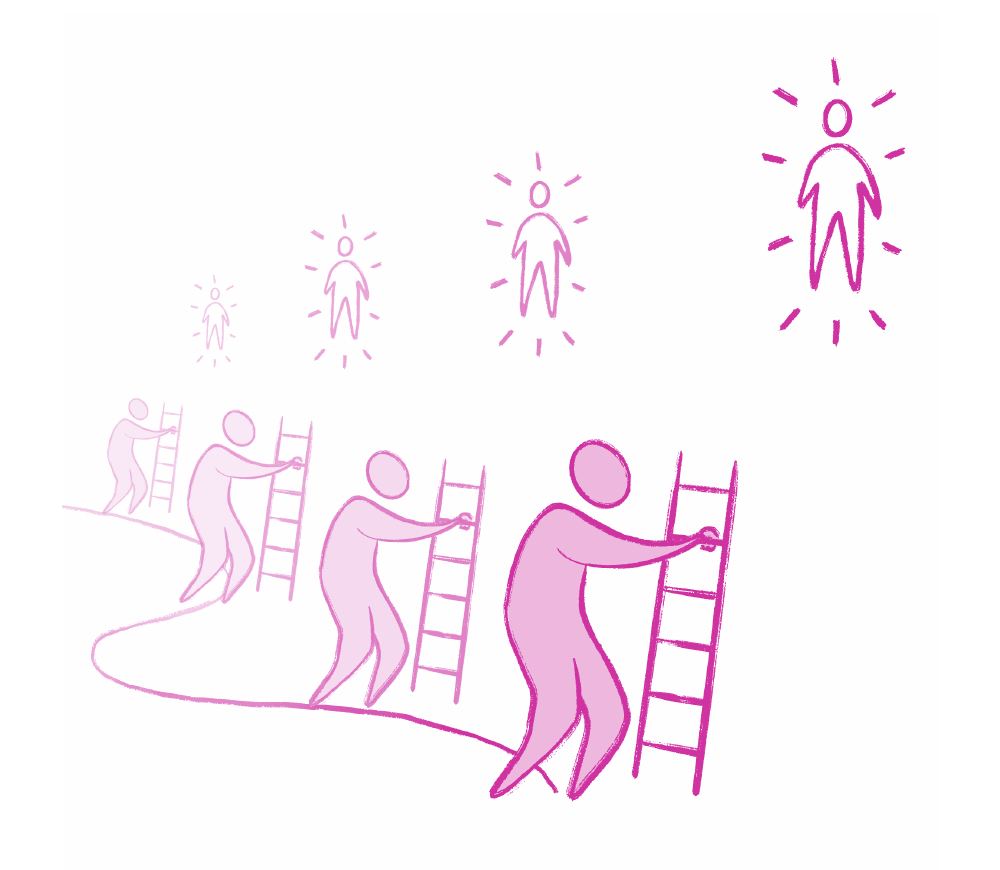
RELATIONSHIP DYNAMIC 8 RD 8: IMPOSSIBLE DREAMS - A MODEL- OBSTACLE RELATIONSHIP - WALKING AWAY IS THE ONLY WAY OUT
INTRODUCTION
Model-obstacles are generated when a person accepts and, at the same time, rivals with impossible standards or expectations of perfection set for them by people they admire. The repeated pursuit of the impossible dreams and the goal of perfection are at the root of model-obstacle relationships.
Below are three settings where this can occur, among many others.
Families: Parents or carers, rather than holding aspirations that are human and reasonable, can set impossible standards for, or have great expectations of, their child. Because the child loves their parents or carers, they seek to please them and strive to achieve their aspirations. The child or young person becomes stuck in a rivalry with these expectations. If it is expected that they will achieve all A’s at school, receiving all A’s except for one ‘B’ then feels like failure, despite it being an excellent achievement. Depression and despondency can follow from such model-obstacle behaviours.
Workplaces, Schools and Colleges: Employers and educators can set impossible standards for the performance of staff and students. When they are unable or unwilling to negotiate these standards, people often uncritically accept the expectations set for them by significant others. They buy into trying to attain something that is impossible from the beginning. It becomes a standard to rival with, a model that becomes an obstacle to their growth and development! Even striving to do a perfect job is a form of model-obstacle. It is an aspect of becoming a workaholic, disappearing completely into our work!
Culture and Fashion: Media portrayals of ‘beauty’ can generate model-obstacles. These airbrushed images peddle unattainable perfect faces and perfect bodies. The message is, “If I am perfect, I’ll be lovable and loved.” Some of us then strive with these ‘unique’ models of perfection, seeking to attain the same degrees of style, shape and glamor. In fact, we are engaged in a destructive rivalry with impossible model-obstacles and we lose our own being.
In all three situations, the results are often self-loathing and depression. In this dynamic we are convinced that it is not that the expectations set for us are impossible; we prefer to buy into the debilitating belief that “we aren’t smart enough, good enough, or beautiful enough to obtain them!”
“When I was young, I always looked in the mirror before going out on a date, as you do, and inevitably my after-shave laden pores exuded a ‘zit’. To squeeze or not? My rivalry with perfection, gaining that perfect face ended in despair and embarrassment followed!”
This is a small example of a model- obstacle relationship with a perfect skin or a zit free complexion! For many people, model-obstacle relationships are more threatening and destructive.
Some young people end up in model-obstacle relationships that destroy their lives and they become depressed.
- The rivalry with the perfect shape, that leads to despair.
- The struggle to please parents and carers who impossibly ‘expect’ straight A’s in exams when only a very small number will attain that level. They may still do very well yet become deflated and even depressed.
- The pressure to conform to heterosexual societal norms when they are LGBTQ+.
Some people buy into political model-obstacle relationships that destroy them, becoming depressed.
- Ethnocentric political identities can be model-obstacles.
- Identity politicians promoting identity purity can generate model obstacles in diverse societies!
- Failure to achieve a political dream based on purity rather than compromise is a model- obstacle and can make people become depressed.
- Terrorists, promoting and failing to achieve an impossible goal of identity purity, can generate a willingness to die for the cause.
For some people sacred religious beliefs can become model- obstacles
- Fundamentalist religious beliefs that brook the voicing of no doubts, can establish a model- obstacle around a purity of belief, a belief that cannot be questioned.
Even, peace itself can be made into a model-obstacle when it is viewed as the goal itself rather than the outcome of people living together well.
RD 8: IMPOSSIBLE DREAMS - A MODEL- OBSTACLE RELATIONSHIP - WALKING AWAY IS THE ONLY WAY OUT
INVITATION
If we feel able to, please make some notes or write a diary entry about how it felt for you being involved in ‘chasing the impossible dream’.
REFLECT ON YOUR OWN
Having read the descriptions of how model-obstacles are generated, can you identify any model obstacles in your daily life? Can you identify any experiences where you were, or are, caught up in trying to compete with impossible standards? If so, can you recall how you felt or currently feel? Were you often irritable or frustrated by them?
Looking back:
- Was there a person you looked up to and were prepared to do anything to attain their attention?
- Was there a media or fashion star who was a big presence in your life?
- Were you prepared to slavishly follow fashion demands or images that proved impossible?
- Were there impossible educational standards you were obsessive about achieving, even when your teachers were suggesting that you should be satisfied with achieving less?
- Which political, social, or sporting dreams were you or are you still following that depend on everyone agreeing with you, something that is plainly not possible to achieve?
On your own or working with another person:
Find Your Voice
- Using this model of ‘impossible dreams’, can you recall such a situation where you, or a group of which you were a member, became committed to attaining impossible standards of perfection?
- Can you recall a situation where, although some people saw the striving to be futile, they went along with the group and never spoke up?
- What was the emotional and physical state of the participants pursing the impossible dream? Did they adopt unhealthy lifestyle choices?
- When and how did it seem inevitable that severe frustration, exhaustion or depression were the only outcomes possible?
- Did any way out of the destructive dynamic present itself?
- Did some people have the courage to walk away from the obsessive pursuits of an impossible dream? If so, what made it possible for them to do so?
What were the end results?
- What were the costs at that time of slavishly trying to be perfect?
- Today, are there any remaining costs or hurts as a result of that model-obstacle behaviour?
Explore Your Reason
In a model-obstacle relationships people lose clear reasons for making the choices they make or the paths they choose. Emotions, not reason, take over the choices people make. Think about one experience in your life where you now realize you were in a rivalry with an impossible standard, yet you kept on trying and trying to attain it. Name the nature of that rivalry.
- Looking back, what reasons did you generate to justify slavishly following this model-obstacle behavior?
Examine Your Choice
- Do you have any experiences where you choose to break such a pattern of behavior by ‘just walking away’?
- Did you do this alone or with the support of others?
COLLABORATIVE ACTIVITY
If you are willing now, speak about the themes above with another person or in the group of which you are a member. After hearing your own voice and the voices of others, what are you now learning about the experience of, and potential for, model-obstacle relationships in daily life?
Summary
It is suggested that slavishly following ‘model-obstacles’ can become obsessive behaviour that is very difficult to stop. It is made more difficult if such behaviours have become a recurring pattern in our lives. It often needs a friend we trust to drag us away from the pattern, to encourage us to shrug our shoulders and to not allow us to look back or stay linked to it in any manner. If the pattern is not broken, the outcome is often mental distress or even a breakdown. When such patterns of behaviour are deeply embedded and continuously repeated, they may lead some people to attempt to take their own lives.