Understanding Relationships
RD 7 Deadly Rivalry And Chaos - The End Of All Differences
The chaotic endpoint where opponents become mirror images locked in danger.
Source: Nurturing Hope, Understanding Relationships, May 22 Final The Understanding Conflict Trust - Nurturing Hope - 3 Understanding Relationships.pdf, pages 35-38
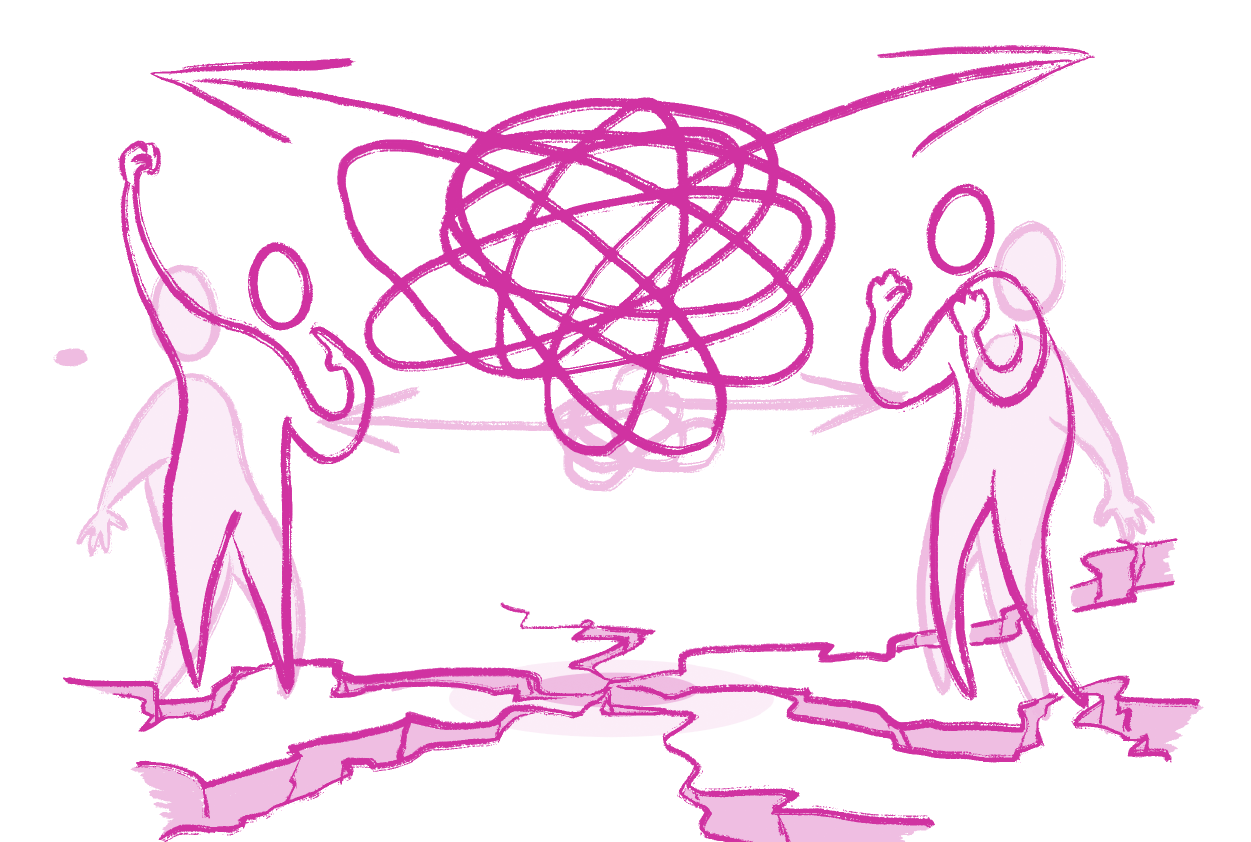
RELATIONSHIP DYNAMIC 7 RD7: DEADLY RIVALRY AND CHAOS - THE END OF ALL DIFFERENCES
As tensions and rivalries escalate until they are almost out of control, both parties gather around one or two differences for which they are prepared ‘to go to the wall’ or ‘even to die for’. Compromise is experienced as capitulation. These beliefs or positions become so undeniably important that they can acquire a ‘sacred quality’. ‘Sacred Beliefs’ take on a life beyond themselves, and even beyond the lifetimes of those who began the rivaling.
They are non-negotiables: “You cannot take them away from us, even if you kill us”, people often say. These ‘non-negotiables’ can become the rationale for on-going personal, social, and political feuds. With time, they become deep, and often, sacred elements of a people’s identity.
As unlimited rivalry escalates and spins out of control, the conflict approaches a final point. Each participant or party becomes increasingly alike in voice, physical posture, and emotional state. They eventually become each other’s mirror image, ‘doubles’ locked in a fight to the bitter end. By now no differences remain, except for those that are non-negotiable and ‘sacred’ between them.
To a neutral on-looker, this can look and feel like deadly rivalry. Serious injury, and even death, can really be the final outcome! How can the participants walk back from this edge? There is little chance of the rivals stepping back from the abyss unless something unexpected intervenes, such as friends literally pulling them apart. However, in such moments of high tension, friends are, more often than not, already aligned and co- opted.
Friends who have managed to remain free of the rivalry may find that their freedom to intervene has now narrowed to one of physical force or of ending their relationship by walking away! Intervention at an earlier stage would have provided more possibilities. Without an unexpected intervention, it becomes ‘win at all costs’ or be defeated. Such a dynamic can lead to violence being used, readily justified by those who use it, and their aligned supporters.
The characteristic of chaos is that, structurally, there is no order. All differences have disappeared. All are in danger. No one is safe.
RD7 DEADLY RIVALRY AND CHAOS - THE END OF ALL DIFFERENCES
INVITATION
If you feel able to, please make some notes or write a longer diary type entry about how being involved in this rivalry made you feel or how you might feel if you got so involved.
REFLECT ON YOUR OWN
Call to mind a time when you have seen a conflict moving towards violence. This might have been a serious violent brawl escalating or the chaos of a vicious shouting match that belittles everyone engaged in it. This is an example of deadly rivalry and chaos. If you cannot draw on an example from your own life, draw on something you have seen in a film, on stage, or on television. You might also consider a story from a newspaper or on the news about a local feud. Place yourself in that story.
INVITATION
TO EXPLORE Whether the situation is something you experienced or observed or are imagining:
- Did you become the double or mirror image of those with whom you were rivaling?
- What were your physical reactions? Did you see the protagonists become physically alike?
- What was the emotional state of the participants?
- Were there any differences remaining in how each party was acting? In what they were saying and their tone of voice? In their postures? In the emotions they were expressing?
- When did it seem inevitable that severe hurt, violence and destruction were going to be the only outcomes?
- Did any way out of the ‘horrible conflict’ present itself or was it inevitable?
- What were the end results?
- What were the costs then?
- Are there any remaining costs from this rivalry?
REFLECT ON YOUR OWN
Find Your Voice
On your own or working with another person: As you recall this situation in real life or in your imagination, ask yourself these questions.
- What positions, symbols, achievements, strengths associated with the individuals or your group were used in an attempt to win in these final stages?
- When you were feeling fairly desperate and when there was little space left between you, what were the differences that you held on to as you made your final push to succeed against the others?
- What differences did the other party see as being core to their position?
- What happened in the final stages with these non- negotiable differences?
- Looking back, how similar did you become to one another?
- Was there any desire to get out of the stranglehold of conflict?
- Did anyone try and use humor or express a desire to break free of the conflict?
- What were/are the costs to you and the other(s)?
Explore Your Reason
- As the conflict escalated, what were the reasons, if any, that you or your group generated to still try to dominate the others?
- Was there ever any possibility of getting space and distance from the emotion of that moment and making a good season to cease?
- Do you think the other person, or the members of the other group were also seeking a way out?
Examine Your Choice
- Given a similar situation now what choices would you make?
- What changes in your stance in this deadly rivalry could have led to something different between you and the other party now?
- Do you now see any possibility, if a similar situation occurred now, that you would choose to avoid deadly rivalry taking you over?
COLLABORATIVE ACTIVITY
- If you are willing, speak about the themes above with another person or in the group you are part of.
- As you hear your own voice and the voices of others, what are you now learning about the experience of such chaotic and potentially deadly rivalries?
Summary
Chaos occurs when there are no differences left between us. In such a chaotic, un-ordered situation, we, understandably, become fearful for our very being. Relationships in which our differences are welcomed are structures that give everyone a valued place. Such structures protect us from the worst actions we are all capable of. Paradoxically, in our modern society, we tend to (wrongly) emphasise that we are all the same. This is a mistake. Too much similarity does not give us enough protective space and structure. We need the space of open diverse relationships within which we value our differences, rather than the stiffness, unease and rigidity of rivalrous relationships that perpetuate the myth of sameness.