Dynamics for Hope
DH 6 Values Shape The Ways We Are With Others
How values such as respect, inclusion, and nonviolence shape life with others.
Source: Nurturing Hope, Dynamics for Hope, May 22 Final The Understanding Conflict Trust - Nurturing Hope - 5 Dynamics for Hope.pdf, pages 58-70
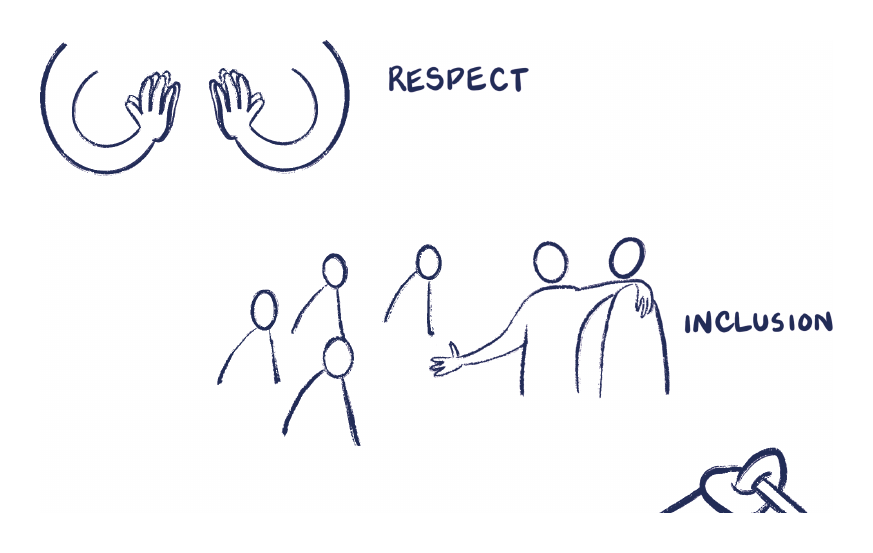
DYNAMICS FOR HOPE 6 DH 6: VALUES SHAPE THE WAYS WE ARE WITH OTHERS
The things we do to care for one another in our family, among friends, with neighbours, with the wider community- locally, regionally and internationally-are at the heart of our life together. To have relationships with others and with groups gives us life, whether they are civic or faith groups, family groups, groups of friends, sports and cultural groups, campaigns for community improvements, workplaces, educational opportunities and many more.
Through these relationships- in families, workspaces, and civic involvements- we are with others we may or may not know personally, and we make visible what we value in real lives. If we are to ensure the ‘public space’ is open and diverse, a space for dialogue where everyone has a place; it is important we create relational atmospheres characterised by open and trusting relationships.
Hope is visible:
-
When our communities and homes are places where belonging is core, and in which robust engagements can occur between all the members.
-
When hospitality is practiced. Hospitality is the art of ‘creating welcoming spaces in which people can experience change’ (see Henri Nouwen).
-
When our homes and communities are characterised by openness to newness and otherness, making space for others, and ensuring that those at the edge of the community can find a voice.
-
When workplaces and civic organisations free our talents and experiences for wider benefit. Healthy communities are marked by the possibility of deep listening and learning, underpinned by the visible truth that each different person is a gift, each person has unique being, and each person has a voice.
DYNAMICS FOR HOPE 6.1 DH 6.1: RESPECT
Respect is experienced in a relationship. We ‘know’ in our very being whether others respect us and others know whether we respect them too. When another person respects us, mimetically it is easy to respond and vice versa. Respect accumulates, and the space for new responses between us grows. We move away from actions that would offend or hurt (actions born out of rivalry) into the gift of actions born out of freedom with one another! Respect is a core value in creating ‘Restorative School’xlii atmospheres.
Maxwell and Buckley, founder practitioners of Restorative Practices in New Zealand, explore respect in a school setting: What are the actions that indicate respect and disrespect? Language that does not belittle or diminish is key but so are more subtle cues such as tone of voice, body language and facial expressions.
Effective listening to one another and the exploring of different points of view is important, as is being fair to everyone, being honest, being trustworthy and making good on any harm that you have done whether you are a teacher or a studentxliii. However respect is for more than just schools, it is a fundamental value in all human relationships that free and transform us, that make us anew. In the subtle experiences together, even more than the words we use, people experience respect!
So when respect is a core value; when it is one of the bedrock norms of a civic group or a public institution, it infuses all aspects of wider life and relationships. Respect is experienced first between people, then it may be reinforced by language.
DH 6.1: RESPECT
INVITATION
If you feel able to, please make some notes or write a longer diary type entry about your experiences and thoughts about respect.
REFLECT ON YOUR OWN
There are some ways we use the word ‘respect’ inappropriately such as “I respect your views BUT.. ” or ‘with all due respect” and we go on to rubbish the position of the other. This is a form of rivalry that takes no risk in establishing an open relationship.
Find Your Voice
To be really respected is an experience of being in a relationship with another or others and not feel uneasy, threatened or diminished by them. When I am respected, I am free to speak my views without worrying whether my views are different to those I am with. Respect is mimetic, it is an experience in a two-way relationship. If I wish to be respected, I must also respect. In a relationship where we are respected there is no rivalry, and we do not have to struggle for a place.
When we are down, excluded or hurt in relationships with others, entering into a relationship where we are respected is an important possibility for healing. Respect is a new and open space between us; it is a space of freedom; a space filled with possibility. When we become mimetic of respect, eventually such an experience enables us to more fully respect those we find ourselves with. An experience of respect may even enable us to meet again with those who disrespected us earlier, in a strong and more resilient manner!
Explore Your Reason
Can you recall a situation where you felt treated with respect? If so, what was your response to being respected? Can you remember an experience where you were, unexpectedly, shown respect? If so, what impact did this have on you? Can you recall an experience where you did not respect another person? If so, what was, or is now, your response to that act? To argue for a habit of respect is a two-way street. It always demands that we treat others with respect. Respect carries with it a personal responsibility to honour the other.
Examine Your Choice
From your experience, what appear to be some of the gifts of people mutually respecting one another? From your experience of not being respected: What factors may have contributed to this experience? If we carry experiences of having been hurt in the past, the history of hurt filled relationships can easily dominate us. However, if in new relationships all can change, can we recall, and speak about, any experiences of new relationships that have enabled us to respect others again? What changes in your behaviour could you make, if any? Prepare a 60 second ‘elevator speech’ on the mental well-being benefits of respect.
COLLABORATIVE ACTIVITY
If you are willing now, speak about the theme of respect with another person or with the group you are part of. Hearing your own voice, and the voices of others, what are you now learning about what respect is? How can we make respect a central commitment in our daily lives? How difficult has it been to respect some people who have treated you badly? How difficult has it been to respect others with whom you are in complete disagreement? In what ways do the norms and structures of the groups or organisations you belong to underpin a culture of respect?
Summary
Respect is an experience in a human relationship, regardless of beliefs and positions. Respect implies an active seeking of an open relationship, devoid of trickery and manipulation. Respect is not a passive action. It implies an active willingness to continue to work at the relationship, regardless of whether divergent views are held.
DYNAMICS FOR HOPE 6.2 DH 6.2: INCLUSION: A PLACE FOR EVERYONE?
It is important for our own health, growth and development that we have some relationships where we unconditionally belong. In relationships where we really belong we can make mistakes. We can even, often unwittingly, hurt others and yet still belong: we still have our place. For as long as we live, in culture every group needs a boundary and a shape to allow it to survive. ‘The limit’ or ‘boundary’ to inclusion allows us to establish standards between members about how we might live in the wider world.
The value of inclusion gives us freedom. Inclusive relationships are spaces where people are not rivals. They are inclusive ‘places to practice’ supporting people live freely and with hope. Such inclusive experiences in one setting can be important in building strong inclusive civil society cultures more generally. Inclusion is a very challenging term because many of us live in groups where those we are at ease with are ‘like us’.
Inclusion, at its best, is a challenge, inviting us to explore how socially and culturally inclusive we are. Social Inclusion practices are now more often about groups being developed that make new opportunities for those in greatest social need to be acknowledged. However a real challenge about social inclusion is whether, and how, all of us, from our different social backgrounds, can be open to meeting one another respectfully and inclusively? What is our response to this challenge?
In light of the recent challenges in mainstream societies, finally having to face into the challenge of people from Black, Asian and Minority Ethnic backgrounds demanding that institutional racism is acknowledged and addressed:
- what does this mean for new discussions and responses around the role of public culture, health, legislation, education, employment, policing and justice? Inclusion is a major challenge for old, often diversity blind, established societies. However, if we can create freeing inclusive spaces in which to meet together and address the historical challenges associated with cultures of separation and denial, inclusive ways forward are also opportunities to nurture hope.
DH 6.2: INCLUSION: A PLACE FOR EVERYONE? INCLUSION:
INVITATION
If you feel able to, please make some notes or write a longer diary type entry about your experiences and thoughts about inclusion.
REFLECT ON YOUR OWN
Inclusion- Experienced as a fact of life together To belong to others, without pre- conditions, is a gift. For some of us this comes from being a member of a family or a member of a secure caring structure. Such experiences are affirming, they nurture hope and possibility in our daily lives. Inclusion-Only being included when we conform, for the safety of all. Sometimes there are certain rules or standards of behavior we have to conform to.
Inclusion has a price when, for various health and well- being reasons, we need some structure and order in our lives. Such demands, often established by a court or medical practitioner, make sense. Such structural demands on the price of belonging can bring order for some of us for our own benefit. Inclusion-A demand, a limit on our freedom, a restriction. There are also groups who wish to control people, impeding our freedom and diminishing our potential. Here, ‘inclusion’ is used as a control on our behavior.
Such groups can have particular beliefs that control the actions of members. To belong is even stronger than inclusion, it is a restriction! When Inclusion makes sense? In earlier materials we pointed to evidence that supported societies being stronger socially and economically when they were more inclusive.
Examples were when relationships between different people from different ethnicities and backgrounds criss-crossedxliv, when the social capital of the society developed because people interconnected, sharing their skills, talents and hopes. In conflict affected cultures and societies this goes counter to the local ‘cultural common sense’ of remaining separate and many people might resist this challenge!
Find Your Voice
Find your way back to an important experience where you felt included by others? Who were the people and what were the circumstances at that time? Were you included unconditionally, or were only certain kinds of people included? Was this an experience with close family or friends? What was your experience of having a place with them? Were there any conditions on being included? If so, what were they, and how were they exercised?
EXPLORE YOUR REASONS
What good reasons would you make for people to be included without conditions? What are the benefits of such experiences? What, if any are the limits? Are there any benefits from groups of people setting boundaries or rules on the behaviours of group members, if they wish to be included? What benefits, if any, do such conditional groups offer wider society? Are there any downsides to such demands? If so, what might they be? EXAMINE YOUR CHOICES How have you responded to being included in a group without any conditions?
Was there any way in which you chose this group, or did it just happen? How have you benefitted from being included by others unconditionally? In your own life, have there been groups where you were only included if you met certain rules or standards? How have you responded to being included only if you met these conditions? What positive benefits were there, if any? What negative sides were there to belonging to this group, if any?
COLLABORATIVE ACTIVITY
If you are willing now, speak about the themes above with another person or in the group you are part of. An exercise: Imagine yourself to be living in an area that has been very settled in its makeup for many years. As people get older they move to smaller homes, enter care or pass away; as families grow up, children become adults and leave; as those remaining enter middle age some no longer experience the area as a familiar place. If you ask local residents, they say, ‘all is changing”.
Existing schools need new children to enroll; different faith communities seem to be welcoming people from much more diverse backgrounds; new groups are springing up; and it is obvious that there is a changing age range of people in the area and a lot of new energy and life! Imagine: You are a member of a Community Group, a School Board, the Board of the Local College of Higher Education, a Cultural Organisation or a Faith Based group. Choose one, preferably something you are less familiar with.
Consider what would be the challenges, and the opportunities for your group or organisation to be more inclusive in this changing area? With only forward looking actions permitted at this time: Make your case for your group or organisation to be more inclusive? What are the benefits of being more inclusive?
Hearing your own voice and the voices of others, what are you now learning about the experience and potential of relationships characterised by inclusion? What are the benefits to being included in a group without conditions? Are there any negative factors associated with such relational spaces? What would be the resistances they would meet from people who do not want them to be more inclusive?
Summary
To be unconditionally included is, for most of us, an important experience. Such experiences are foundation blocks; they build personal resilience and confidence. Such relationships can positively shape our behaviour, influence our choices and sustain our hopefulness for years into the future. However, if we are in a group where belonging restricts our development, or limits our capabilities or choices to be more open, we need to examine such a group critically.
DYNAMICS FOR HOPE 6.3 DH 6.3: NO-VIOLENCE
Violence destroys people, and long after the actual acts of violence legacies of deep trauma continue across the generationsxlv. ” Northern Ireland is interesting because it suggests that it is not merely a question of things - objects, which can be measured and doled out - or of quantities, but a question of relationships. The quality of relationships between competing and often violent claims to power is ultimately decisive in a conflict.
In a context where violence begets violence rather than victory, the unavoidable political challenge is finding a way to make a future with one another rather than against each other. The ending of conflict is not a theory, it is an experience of newness whose key indicators are all about doing things in previously unthinkable ways and learning to be comfortable with it: but it is always learning to do what we do not know quite how to do.
The emergence of a new (no- violence) culture depends on having different conversations, involving old partners and new partners in unexpected juxtaposition and in a willingness to think creatively as each institution or relationship has to make room for new realities.” Morrowxlvi’ We are mimetic with the ‘violence’ and ‘no-violence’ characteristics of our relationships.
We are violent either because: it is how we have learned to react to tension; we repeat ways we have learned over time (temporal mimesis); or because, in the present moment, we are easily drawn in to the violence of the other (spatial mimesis). Likewise, we are not violent either because we have models whose no-violence has become part of us through: mimesis with a parent, a role model, a cultural tradition, a faith model; or because we respond to the no-violence of somebody else in the room or nearby.
Such models of no-violence ‘free us’ or ‘save us’ from being mimetic with any violent behaviours in the room or around us. The more we experience being in the vicinity of people who do not wish to be violent and the closer we are to experiencing it, the more no-violence becomes our reality. However, without these strong models, we, like others, are easily drawn into mimesis with violence and join in the escalation. We might also recognise the face of the scapegoated victim.
Girard directs us to a further possibility: ‘no-violence’ is mimetic behavior in which we have the possibility to recognise the face or experience of the victim and gain a new freedom.
Until now, the unanimous violence of cultures against scapegoats gave us cultural peace. In unveiling the scapegoat mechanism for what it is, an arbitrary action against an innocent person or group, we have to now recognise that ‘our peace’ is built on these scapegoating actions. In recognising this dynamic we acknowledge our participation, historically or actually now, in a history of scapegoating. So many nationalist cultures everywhere have, for many years, hidden the violence associated with their foundation.
Currently, the challenge to look at the impact of slavery on the wealth of different families has opened up the previously often not unacknowledged history of the slave trade. The claims of many victims and survivors of historical abuse forces religious and political cultures to address secrets covering up such violent or degrading acts in their history too. When the scapegoat mechanism is unveiled, both the possibility of unanimity and silence, or the cultural belief that we are innocent, have disappeared.
As human beings then we only have two options, to deny what we have learned and, once again be more violent- or turn from being violent, recognising the other as a human being like ourselves and change. This means working to change the situation between us, non violently, through acknowledgement, restitution and, possibly, even forgiveness.
DH 6.3: NO-VIOLENCE
INVITATION
If you feel able, scribble some notes or write a diary type piece about your experiences of no-violence.
REFLECT ON OUR OWN
To do no-violence is to act in a way that: uses no force; does not hurt or abuse others; does not isolate or cause harm. To do no-violence includes our speech; not using what some would call ‘a violent tongue’ . There are many arguments about whether violence is part of our human makeup (our DNA) or whether it is learned behaviour, developed through us imitating others acting angrily and violently around us and in the actions of cultures over many yearsxlvii Our understanding is that violence is a learned behavior. Our hope is that we can learn, together, to behave in ways that show ‘no-violence’xlviii.
Find Your Voice
No-Violence In which areas of your life has it been possible to hold on to a culture of not being violent to others? What have been / are the benefits of not being violent? Can you recall a time when, with others, the anger or threat levels were high, and someone, or some people, calmed things down through not being violent? Was it totally unexpected or, knowing those people, would you have expected them to calm things down? What impact did this have on you, if any?
Explore Your Reason
From the above experience, what good happened from people drawing back, not resorting to violence? Did any people, shocked at what nearly happened, resolve to act differently after this? OR Do you think that many would just as easily get caught up in the same dynamics again?
Examine Your Choice
Can you recall situations where, through not joining in with violent expressions or actions, relationships with different others have improved? Can you identify groups of friends or colleagues; members of ‘gangs’, groups or teams you belong to where abuse or violence, too easily, takes over? What, or who, do you need support from to prevent you from acting in ways that resort to violent or abusive behaviour?
COLLABORATIVE ACTIVITY
Share your different experiences and feelings of being in groups characterised by ‘no violence’ with those prepared to use abusive or violent language, or even be physically violent. Are there any opportunities for you to promote ways of ‘no violence’ within the groups you belong to? Are there others who model ways of not being violent? If someone is scapegoated or excluded how do you think they feel? Do you think it is possible for people who have had violence done to them to respond in ways that are not violent, in return?
Are there benefits from establishing a value of no-violence? Would there be financial benefits to building a culture of no-violence? Is it possible for a group or organisation to hold those wishing to act violently to account? What would be the physical and mental well-being benefits from building such a no-violence culture between people? Is it possible for you to choose to act in a way characterised by no- violence to others? If so where does that strength come from? What do you believe?
Would you ‘go the wall ’ and defend someone who is being devalued and mis-treated? (See Upstanders and Bystanders resource at www. corrymeela. org) Is your daily life guided by ‘relationships are more important than power’?
-
In your group of friends?
-
With those you are rivalling with in school, college, work or elsewhere? How might living to a certain value of no-violence contribute to a more open, just and interdependent neighbourhood, town, society, or world? Who has been the person, or what has been the reality, that has allowed you to avoid being drawn in to responding violently? No Violence In which areas of your life has it been possible to hold on to a culture of not being violent?
Summary
Kay Pranis (1987) argued that all human beings have dignity and value, that relationships are more important than power and that ‘the personal is political’.xlix The ‘personal being political’ means that the actions of each person have an impact, for good or ill, on the quality of life in society!