Dynamics for Hope
DH 5 Principles to Meet and Work Together By
How equity, diversity, and interdependence support relationships that can work together.
Source: Nurturing Hope, Dynamics for Hope, May 22 Final The Understanding Conflict Trust - Nurturing Hope - 5 Dynamics for Hope.pdf, pages 41-57
DYNAMICS FOR HOPE SOME PRINCIPLES AND VALUES UNDERPINNING RELATIONSHIPS, WORKING AND LEARNING GROUPS, ORGANISATIONS AND PUBLIC POLICY.
DH5: Principles to Meet and Work Together By
- DH 5.1: Equity
- DH 5.2: Diversity
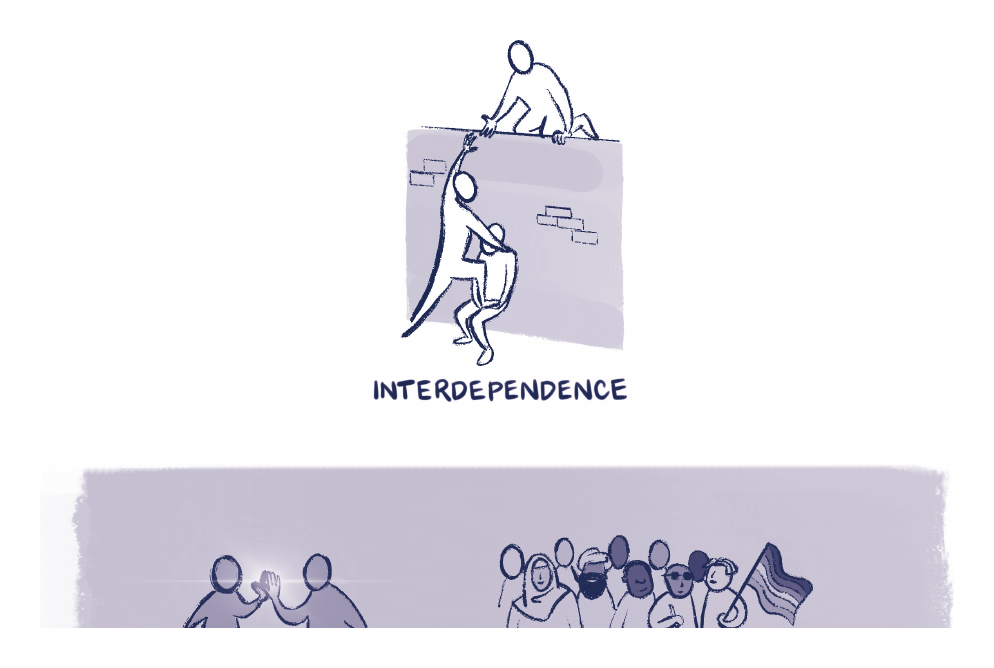
- DH 5.3: Interdependence
- DH 6: Values in Our Orientation - Values Shape The Ways We Are Together
- DH 6.1: Respect
- DH 6.2: Inclusion
- DH 6.3: No-Violence
DYNAMICS FOR HOPE 5 PRINCIPLES TO MEET AND WORK TOGETHER BY: EQUITY, DIVERSITY AND INTERDEPENDENCE
From fundamental research in 1995-7 we found that a sustainable and prosperous society is best underpinned by the inter-related principles of fairness (Equity), an acknowledgement of our differences (Diversity), and an understanding of the importance of mutual respect in our relationships together (Interdependence) xxix.
In our experience these three principles are lenses we can practically apply to:
-
our day-to-day lives with one another;
-
our different relationships, organisations and groups;
-
our practice in group work, community organising, and school cultures;
-
groups within which we learn, formally and informally;
-
the policies of public and civic agencies;
-
the systems of governance we work withinxxx.
The ‘Nurturing Hope’ materials are rooted in the understanding that in relationships and structures characterised by trust, lasting changes for the common good can be promoted. In societies where conflict has escalated people separate, take sides and establish distance. Paradoxically, the relational space between them is small to non- existent! Finding a way to a future together means re-establishing principles about how we come together, new reasons to try again!
In Northern Ireland, we have found that these three principles mattered if we are to break free from endless rivalry between people and cultures. Together they emphasise the need for a vision big enough to encompass everyone. 1 See Facilitators Guidance 4 The Reflective Group Ethos Drawing on two community studies, 27 organisational studies across 12 sectors in civic, business and political life, and 2006 questionnaire responses, we identified these three interweaving principles to be essential to:
-
establishing policies to nurture trust;
-
inform the ethos of groups1 working and learning togetherxxxi and
-
the cultures of diverse groups and organisationsxxxii.
They are also transcending principles to return to when rivalries begin to separate or polarise us, and our common sense of belonging together begins to fade. Each principle has aspects that require laws, even enforcement. In that sense they belong to culture. However for the principles to be experienced as human and sustainable, they have to have a life outside and above the law.
It makes sense to experience them as realities sustaining our daily lives, infusing our institutions, giving meaning to the ways people are together and shaping our cultural norms. These principles make sense in our personal lives-to be treated justly, to be valued as different and to belong are deep realities everyone yearns for. We certainly do not like it when we are challenged or exposed as being unfair, discriminatory or willing to exclude others.
Good Law is Necessary but not Sufficient
When we rely on laws, this can quickly become a question of ‘the good people’ and ‘the bad people’, polarising us again. However when we face one another personally, it is about acknowledging hurt and our poor behaviour and seeking new ways together. When we have lost our way, we need principles to find our way back to relationships and places in which we experience that honesty and truth are not frightening but a relief.
Reconciliating and forgiving give us experiences, not of sentimentality, but of a second (or fiftieth) chance to change and still participate! Such returns to human reality are supported if the wider civic culture and the ‘public space’ are committed to support fairness, diversity and interdependence. All of this will require us to take risks and to allow others to risk, even to be open and sometimes vulnerable with the ‘different other person’ in the hope of creating more open relationships.
This challenge is perhaps hardest for people who find out that they belong to those who have mostly experienced life as ‘winners’, where to hear the truth from different others may sting and where their forgiveness may seem unlikely. However without this movement towards fairness, acceptance of variety and making a place for all, the only other alternative movement is a retreat towards polarisation, anxiety and suspicion and, from there, towards violence.
We all now face the challenge of working out what it will require to get along with one another as human beings, equal, different and together in one place! For some this may seem exciting; but for most of us, within the comfort of our own groups, it will be important to acknowledge how much we have led separated lives. Conflict affected cultures do little to equip us for this new task!
Living in ways where hope is alive means: making sure that each person is treated with fairness, justice and mercy; (Equity) making space for one another’s different contributions, abilities, cultural traditions and histories within one common civic sense (Diversity); and making real a shared sense of belonging to one another (Interdependence).
They are also ways to tell when things are going wrong between us: Injuries are measured where there is no equity; When there is no acknowledgment of personhood, diversity is challenged, When barriers to belonging are erected, interdependence is threatened.
A shared and interdependent future together is experienced: firstly in the relationships immediately around us: our families and friends; secondly when it is embedded in experiences together locally; thirdly, increasingly we know that we are interdependent with people far away, whether about our climate, our economy, our safety in a pandemic or the future of our own society. We are all deeply interdependent and inter connected. Now, to promote hope is to see these three themes as an integrated whole, not separate, and draw from wider public debates that have gone on for decadesxxxiii:
-
The World Council of Churches spoke of the need to build a world characterised by ‘Justice, Peace and the Integrity of Creation’xxxiv in the 1970s.
-
In 2005, Kofi Annan’s call to the United Nations integrated the themes of social justice, global interdependence and the environment.xxxv
-
The Covid-19 Pandemic has brought the challenge of tackling a virus worldwide into sharp focus. Countries need to work interdependently. People from diverse backgrounds and cultures now have to re- negotiate their relationships in many societies. Societies where one group has traditionally dominated the political and civic discourse are now being challenged by other voices that need to be acknowledged and heard.
DYNAMICS FOR HOPE 5.1 DH 5.1 EQUITY
Equity is about being treated fairly by others; it is about ensuring that people from all sections of society have equal opportunities to participate in economic, political and social life through redressing inequalities. Based on the foundations of equality of opportunity: equity, according to the Collins English Dictionary, is the quality of being impartial, or reasonable fairness in law and jurisprudence, it is founded on principles of natural justice and fair conduct.
In liberal democracies, the commitment to equity is a commitment to the impartial and fair allocation of resources and entitlements - including political power - according to expected notions of fairness and without discrimination. Equity encompasses the process of redressing any identified undesirable or inequitable balance. Equity is about recognising partisan differentials that exist and doing something about them.
Equality of treatment alone is about ensuring that everyone is treated equally, but it does not necessarily address existing differentials, as equity does. The history of equity in Northern Ireland is dominated by conflictual relationships between a majority and a minority community.
It is therefore not a matter of simple causality in saying that once economic differentials are decreased, community relations will improve or, alternatively, that if communities understand one another better, or get on better, then jobs will somehow proliferate. Equity affects interdependence and raises issues of diversity.
This is not to say that they should all have equal priority in every context, but if there is an economic development project, then the impact of such a project on community relationships and diverse identity groups must also be taken into account.
DH 5.1 EQUITY
Equity is not just about treating others the same, equally. It is about putting right an inequality and then treating others as equals! Some examples are inequalities caused by a history of unfair treatment such as: having no money; having the odds stacked against you because of social inequality; belonging to a group that has historically been discriminated against; experiencing institutional discrimination on the grounds of race or gender. Sometimes it is that people have not been given their place as fellow citizens, a space where they are equally valued.
INVITATION
Please scribble some notes or write a longer diary about how thinking about equity has impacted on you?
REFLECT ON YOUR OWN
To be treated fairly and given our place, feels right. To be with others and not have to fight for attention or rival to get noticed, is a very important building block in life. Not all people experience this. A Private Activity: Recall a situation where, unexpectedly, you were treated fairly by someone. What was your response? Did any of your pre-conceptions about that person change when you were treated in this way? Were you able to respond to them in a different manner than you normally would have?
Recall a group you are identified with, or that you have read about, that is arguing to have greater recognition in society. How does the group you identified or read about make their voice heard? What has been, and is, the response of other people to these demands?
Find Your Voice
If you identified a personal example earlier: think back to that relationship: What is the state of your relationship now with this person? Did your experience impact in any way on other relationships you had? With the group you identified: What has been your experience of expressing your voice about this group in your wider community or society? What challenges did, or do, the group members face in ensuring their experiences are acknowledged by others? If you did not express your voice, what prevented you doing so?
Thinking about the group you identified as wanting greater recognition in society. What has it been like to raise your voice about the group and meet others who were supportive of you? What has it been like to raise your voice about the group and meet others who were opposed to you?
What was it like for the group you identified when they raised their voices more strongly?
Explore Your Reason
What reasons does the group you have identified put forward in support of their case? Do you think it is possible for the group you identified to voice their demands in ways that engage other people, and not make opponents out of them? Take 5 minutes to prepare a 60 second speech for a ‘soap box’ where you are arguing: ‘some reasons why it is important to treat others fairly!’
Examine Your Choice
Looking at other relationships you are involved in: Are there some relationships you would now choose to make more open and fair? What would this demand from you? What could be the benefits of you taking such actions? In the experience of the group you identified, are they listened to and acknowledged more by others now? To be heard and responded to is everyone’s wish. What choices does your group, or the group you have identified, now have to consider making in order to secure their fair treatment? Do you think the groups will secure some changes to their situation and treatment?
COLLABORATIVE ACTIVITY
If you are willing, speak about the themes above with another person, or in the group you are part of. Hearing your own voice and the voices of others, what are you now learning about the experience and potential of treating others equitably? What must it feel like to have to argue for fair treatment, when you do not experience being treated fairly?
Summary
Treating friends and neighbours in a fair manner might not be a challenge for some of us. Treating different others might be more so! How might this be explained? How would we respond if, because of equity measures, someone in more need had to be given a place before us in the queue for a council house allocation? How would we respond if our operation had to be put off because someone with a more advanced condition had to be given a date we had thought was ours?
How would we feel if some children in the school got more additional help than your child received, because, on equity grounds, they were in need of that support? Equity is a wonderful principle. However it is it easy to hold principles as long as we never come up against experiences where hard choices, on equity grounds, have to be made because resources are limited?
DYNAMICS FOR HOPE 5.2 DH 5.2: DIVERSITY
Each of us is unique. People bring something with them that is uniquely ‘theirs’ . We are also inter-related-no single person or group knows, sees or understands everything! Sometimes we see other people as competitors for the same objects and we can get caught up in escalating rivalry. In these materials we encourage everyone to see other people as contributors to the common good. Each person brings talents and experiences-‘things’ for the benefit of all such as skills, insights, abilities and knowledge.
The principle of Diversity gives voice to these experiences. Our differences as individual human beings, and as members of groups, can improve the quality of our lives and our thinking togetherxxxvi Every society consists of a range of different groups and people, in which our ‘identities’ are influenced by our experience of inheritance, life and culture. Some of these may be especially influential such as: our religious traditions and experience, our ethnic history, our experience of the economy, our sexual orientation and more.
Some of our identity is shaped by our experience: the times we live in, the families we live in, the place we live in, the school we went to or go to. Our personalities are also influenced by how we have experienced life: as people who were excluded or included in important decisions: as people who feared violence or used violence to defend ourselves and those close to us: as people who were ill; as people who were injured; as people who tasted success. Society cannot be human without diversity and difference.
Unless we find it possible to create relationships and structures devoid of rivalry, at least in part, one of the problems of mimetic rivalry is that we readily become more and more the same. Girard suggests that human cultures were so concerned about this that they instituted ‘fixed differences’ which gave everyone a place based on external characteristics. In our modern world many of these ‘differences’ have disappeared. We no longer have fixed places that defined our lives and often limited our freedoms!.
This opens up huge possibilities, but it also creates risks that we will always meet as competitors, increasingly the same. Creating spaces where people can really speak with their own different voices rather than compete is very important. It is our experience that this results in unexpected insights, in stories that are told and understood through different lenses that change us. Such stories are about the importance of the other, not as strangers but as key people in and for our lives.
From this insight, it is possible to turn the question of diversity on its head: it is not a question of different people and groups ‘demanding’ their say, but a question of opening forums where difference can become a vital part of making the future, to be encouraged but not feared. For that to be true, diversity has to be married with equity, as each contribution is valued. As culture weakens, so the differences that belonged to culture are challenged. As this happens, so a new battle for power begins.
In this changing environment the critical question is how we ensure that our newfound opportunities to hear diverse voices are not consumed in rivalry. The challenge for liberal democracies, founded on equal representation for all, is how to give proper space to different voices, experiences and groups. The commitment to Diversity in public life therefore sits alongside the commitment to Equity (fairness) and inclusion as a central part of democracy:
-
How does and should democracy give voice to different identities?
-
Is equality possible if people are different, or is there no equality unless difference is taken into account? These dilemmas can be applied to health care, education, religious freedom, the right to vote, and employment opportunities.
-
Can all individuals be recognised equally as members of the human race without also recognising each person differently?
-
Do we deal with difference on a personal basis or are there some characteristics where rivalry has left such a scar that we need special measures (race, gender, disability)?
-
Should people residing within a single state be recognised in terms of belonging to one identity group only, or can there be differences?xxxvii
By now, these are old, but still vital, debates. They can be particularly challenging when different groups live together. Can different identity groups only demand public recognition within certain reasonable boundaries, prescribed ultimately by the maintenance of just relationships between individuals and groups?
Sen argues that when people are too readily herded into structures and policies that view them primarily as members of a single identity ‘community’ or a ‘society of communities’, these mental models sometimes reinforce sectarian, monocultural or exclusive religious and political identities and leaders. Such ways work against the possibilities of promoting a base of equal and diverse individual citizens, undergirded by basic rightsxxxviii.
5.2 DIVERSITY
INVITATION
If you feel able to, please make some notes or write a longer diary type entry about your experiences and thoughts on diversity from these reflections.
REFLECT ON OUR OWN
In what ways do you see yourself as being different to others around you? Family name, gender, nationality, language spoken, religion, history, culture, other? Interests in terms of sport, artistic pursuits, distinctive markings or dress codes? For you, what differences, if any, need to be more publicly recognised or acknowledged? What would that look like in practice?
Find Your Voice
a. In your own life, can you recall what it feels like to be excluded because of some part of your identity? Have you had to argue or ‘fight’ to be recognised? What were others denying you? How did you feel? How did you respond? OR b. Have you excluded another person because of some part of their identity? Looking back can you bring to mind how this reaction came about in your life? Are you aware of having thought less of people you saw as being different, and then changing your mind? Are you aware of friends who have had to fight for their place because of some aspect of their identity? What was / is their response?
Explore Your Reason
Have you been accused of belonging to a group who do not acknowledge people from minorities as equals? How did you react to that accusation? Have you belonged to a group who felt that they were not being acknowledged? What did, or does, that do to the members of that different group or tradition? Make a list of the reasons people give to justify ignoring different others as equals?
Examine Your Choice
In today’s world, where so many people are moving between countries for education, travel, work, asylum and sanctuary, how should we structure affairs to ensure we do not end up in polarised camps? What problems will a failure to address new relations between diverse people cause? What reactions will people in your local group, community or organisation have, when asked to value differences more? What challenges will your politicians face about the need to acknowledge differences?
COLLABORATIVE ACTIVITY
If you are willing now, speak about the themes above with another person or in the group you are part of. Hearing your own voice and the voices of others, what are you now learning about the importance of acknowledging difference more? What are the real challenges to creating a more open society where people from different histories and backgrounds are valued? How might we free up communities to encourage the expression of artistic, religious, linguistic, sporting and cultural differences and others?
What might be the positive benefit to wider society if more diverse expressions of identity and experience were embraced? In acknowledging greater diversity, do we need to make changes to policing, the courts and political representation? How might this be done?
Summary
Mostly, people in dominant cultures do not really think about minorities2! People in majorities start from assuming that life proceeds in a certain way- we often call this ‘normal’. Many people may be unaware of the costs of this way of living for others, or may not even be interested to find out. If we have had a majority experience and do find out that some people do not experience fairness in life, we sometimes do not want to acknowledge this new knowledge or ‘see it’.
However in our modern world, it is becoming more difficult ‘not to see’. How we react to this new world will decide our common future-whether we go into ‘denial’ and withdraw back into our old ‘normal’ ways or whether we find new ways to move forward together into something new? In this context, trying to find back to ‘singular’ or’ solitarist’ views -that one culture is best.
“can be invoked for the purpose of dividing people into uniquely hardened categories, and can be exploited in support of fomenting inter group strife… making the world more incendiary”xxxix. This still can be very attractive to people under threat.
2 See DC7: Majorities Assume while Minorities Negotiate Senxl argues we need to re-learn that for centuries, the world has been a deeply interdependent place and that the development of key ideas and practices in: ethics and morality; medicine; mathematics and science; art, literature and music; have come from diverse people working together from many countries and regions. For many of us this is often new information, something that dominant cultures did not acknowledge or teach!
He argues that the roots of democracy have developed over many centuries before, as well as within, a ‘so called’ western cultural dominance. Also even in some cultures dominated by a particular religious tradition, there have been concrete, and in today’s terms, surprising, examples of leaders, such as Akbar, the Moghal leaderxli, holding a valued place and space for religious and cultural minority identities in their midst.
Such cultures hosted them because of their value to the whole community and respected their views being expressed in the public arena. In short, and to be encouraging, there have been, and are still across the world, examples of people and groups actively nurturing and sustaining the seeds of really human ways of life together! Such people and groups nurture hope!
DYNAMICS FOR HOPE 5.3 DH 5.3: INTERDEPENDENCE:
“…no theory of justice today can ignore the whole world except our own country, and fail to take into account our pervasive neighbourhood in the world today, even if there are attempts to persuade us that it is only to our local neighbours we owe any help to overcome injustice…. There are few non-neighbours left in the world today” Amartya Sen, 2009, p173 Interdependence is our reality One Covid 19 impact, among many others, is a stark reminder of how interdependent we all are globally.
The only way we will all have possibilities to live more fully is when the whole world is protected, not just individuals in rich countries! In a shared society, in a shared world, our futures are interdependent, whatever we do. The only choice we have is to change the quality of our interdependence. To acknowledge that we are interdependent means taking our relationships, and our contributions to them, seriously. It is not enough, in any society, to talk about justice (equity) and identity (diversity) on our own.
In reality, our relationships with one another, and the quality of these relationships, are decisive for each of us. ‘Ourselves alone is a lie’. This is in spite of what we may wish, or what many nationalisms argue. The health of the other is crucial to our health now, and vice versa, at a global level. We are globally interdependent! Some of the authors of this text come from Northern Ireland, a place where people from historically opposed political and cultural traditions have to find a way to live and work together.
In addition to old historical patterns of settlement feeding our recent conflict, in recent years, as immigration into Northern Ireland has increased, all established residents from diverse histories and identities are having to face the challenge of living in the midst of a changing demography. Hopefully seeing this challenge as an invitation, how might we nurture hope in the midst of these changes? Acknowledging interdependence means that we have to take our responsibilities seriously.
In a relationship the only part we can change is our own part and this means we have to pay attention to:
-
Self reflection.
-
The consequences of our actions.
-
The costs of past relationships that we did not or could not pay attention to.
-
Meeting, perhaps negotiating, with others whom we may have previously avoided.
-
Learning together so we might reduce fear, exclusion and discrimination.
-
Histories of fear and distrust easily destroying any prior commitments we have made to interdependence.
Some people respond that ‘Thinking about others is too hard, it is best ignored’ . While this may be an understandable response, especially in many societies undergoing rapid change, there is a human cost to not facing into this, that cannot be ignored. The cost is in terms of mental health and well being; hurt and trauma; unacknowledged and unused talent; histories of regret and loss.
If we are not to descend into mutual recrimination and fear, leaders within public and civic organisations, and the practice of community workers and educators, among others, have to examine the extent to which the groups they lead promote or dilute a quality of interdependence that opens the future to everyone. These ‘Nurturing Hope’ materials are intended as a step in that direction.
They are offered from extensive and deep experiences that it is possible to find more open relationships and repair structures, even in societies dominated by conflict. Instead of entering into increasing fear and despair, we found that it is possible for people from very different experiences and loyalties to build some interdependent relationships and structures that nurtured, and nurture, some hope. In the midst of conflict, this story often appears unimportant or secondary.
However it is about how the story, voices and actions of victims and survivors of inhumane treatment now become the foundation of a new, more human world. Our hope is that these materials will amplify those stories.
DH 5.3: INTERDEPENDENCE:
Interdependence is about recognising that we are shaped by our relationships, even when we do not recognise it. Our future is dependent on the quality of our interdependent relationships with one another. (Eyben et al, 2001, p21)
INVITATION
If you feel able to, please make some notes or write a longer diary type entry about your experiences and thoughts about interdependence.
REFLECT ON OUR OWN
Can you remember a difficult time or situation when, unexpectedly, you were stood with and supported by somebody? OR: Can you recall being at an event or project where people from many different backgrounds and experiences worked well together, to your surprise??
Find Your Voice
What do you remember about that occasion? What surprised you? Did this experience cause you to think differently about being together with different others?
Find Your Voice
Are there any places where you have often felt a stranger? A house, a family, a town, an organisation, a group etc. Are there groups of people who fill you with fear or anxiety? Do you know the origin of this? Do they fear you? Do they ignore you? Have you ever been made to feel at home by someone unexpected?
Explore Your Reason
How did / does your culture prepare you to meet different others? Have you ever experienced being in ‘another culture’, different to your own? What were the upsides and downsides of this?
Examine Your Choice
Who are the groups of people you do not know well whom you would most like to meet? Are there groups of people in society you would rather avoid? How could you take steps to engage with those with whom you now realise you are interdependent with, but do not really know well?
COLLABORATIVE ACTIVITY
Hearing your own voice and the voices of others, what are you now learning about the experience and potential of interdependent relationships? Could you develop a 60 second argument in support of: “Why we now need to be more open to people from different backgrounds and cultures?”
Summary
Interdependence is the condition of our lives. Social and cultural divisions in the past are now breaking down and, at the same time, some of us are reluctant to reach out and meet different others. We still carry many attitudes and behaviours from our separating pasts. In such a context, making space to explore how we go on together becomes a vital element, not only about our personal life but also for our organisations and societies.
Our futures depend on each of us being willing to change to an interdependent reality in the face of our new, diverse societies. This will require us to attend to the quality of our relationships. It also means that democratic governments have to promote a greater acknowledgement of the values of difference as well as our common interdependence.
Treating people fairly, valuing differences and promoting a common sense of being interdependent, one with another, are important tasks for government, and in the governance structures of public and civic organisations. Workplaces, community organisations, public and civic spaces, schools, and universities are all places where we have the possibility of unlocking the gifts of interdepending between very different people.