Dynamics for Hope
DH 4 Relationship, Agency, Voice and Structure
How trusting relationships help people recover voice, agency, and structure.
Source: Nurturing Hope, Dynamics for Hope, May 22 Final The Understanding Conflict Trust - Nurturing Hope - 5 Dynamics for Hope.pdf, pages 37-40
DYNAMICS FOR HOPE 4 DH 4: RELATIONSHIP, AGENCY-VOICE AND STRUCTURE
We have been reflecting on relationships in which we rediscovered freedom, the freedom to make decisions and to find our voice and place. In open and trusting relationships with others we give each other freedom, the freedom to make choices and to own our responsibility. This is what we mean by ‘agency’. Like everything, it is a consequence of open and trusting relationships that are the antidote to relationships that keep us enslaved in rivalry, fear or in resentment. When we are given agency, we are able to:
-
choose to participate in the world in ways that gives others agency;
-
make room for people to make a change in their circumstances;
-
act out of a guiding purpose and identify actions to help us move there
-
speak more freely about our hopes.
This is a paradoxical process: the more we find relationships in which we are given freedom, the more we find our own freedom and give it to others. Real relationships make agency possible, agency which opens up other relationships and the agency of others. Instead of taking space from each other, we make space with each other. Real change in our relationships changes our civic actions, our community service, volunteering, political activism, and more.
Such changes create space between us, moving us away from acts dominated by revenge. This kind of agency makes it possible to problem solve, take ethical responsibility more seriously, think for ourselves and express ourselves as well as negotiate with, and hear others, able to change our minds without resentment. Free and open relationships are structures that make agency possible. Agency is visible when we can examine sensitive issues together, make changes to power structures in our groups and give one another the freedom to act.
This kind of agency creates new social capital. We all grow through such experiences of being together, making real co-operation and collaboration possible. Such personal agency also helps us to reconcile tensions and dilemmas where we are all grappling with competing demands, and to avoid coming to premature conclusions based on old histories of rivalry. In such moments we recognise our inter-connectedness!
DH 4: RELATIONSHIP, AGENCY-VOICE AND STRUCTURE
INVITATION
If you feel able, scribble some notes or write a diary type piece about your experiences of Relationship, Agency- Voice and Structure.
REFLECT ON YOUR OWN
Can you look back to a situation where you were able to speak freely with others and where you benefitted from being heard? Reflecting on these experiences:
Find Your Voice
What gave you the confidence to speak openly with this person or group? What did it feel like, being with them? How did they respond to you? Was there any previous history between you, or was this a completely new group? Looking back, what did you gain from this experience? What was different and significant about this relationship? Has it continued, or has it given you the confidence to take a risk of speaking more openly with others, since then?
EXPLORE YOUR REASON In what ways did this affirming relationship change how you now react to meeting people? In the light of this positive experience, what activities do you now feel more able to get involved in? EXPLORE YOUR CHOICE What advice would you now give to others who withdraw from relationships and choose, more often, to remain silent? Looking forward, what possibilities can you now imagine yourself getting involved with locally or wider?
Prepare a 60 seconds talk on the importance of developing more open and trusting relationships with others?
COLLABORATIVE ACTIVITY
If you are willing now, speak about what you have found with another person or in the group you are part of. Talking and listening together, what are you learning about the experience of developing relationships in which you find a way to speak freely? What benefits have come from this experience?
Summary
We all have our reasons for protecting ourselves. In the end, they go back to the fear of being the scapegoat so we try to ensure that we are not embarrassed or isolated in company. For some of us, previous experiences of being uncomfortable with others can get in the way of us being open to people in new settings. We even may react defensively to people who actually wish us no harm or discomfort. Mimetic with past hurts, sometimes we can fail to see new affirming relationships, being so caught up in anxiety or a fear of being hurt!
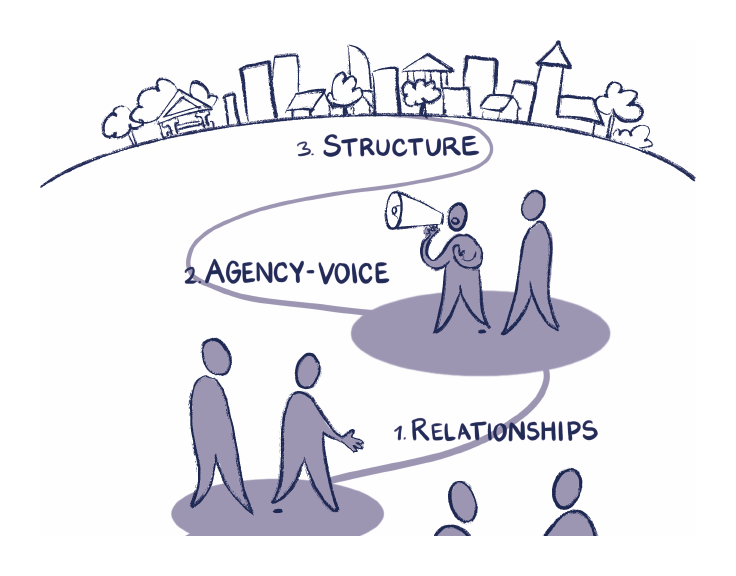
In such moments, staying with our established habits, the opportunity for growth disappears! It is always important when bringing diverse people together to create activities, meetings or experiences to that affirm the importance of: Relationships: where the space between people is free of rivalry and tension, welcoming and inclusive. This is especially the case when the group includes people who have been marginalised or whose contribution elsewhere has been pushed aside.
Agency-Voice: the group offers a space where the different life experiences of each person are acknowledged, the contribution of each person affirmed and their voice heard. Structure: there is respect and dignity accorded to all, whether it is a small meeting between some people in a group or in a larger organisation. Such experiences of each of us being secure in our relationships, affirmed in our power of agency (our ability to contribute to the common good) and belonging to a structure, as of right, are deeply restorative.