Conflict-Affected Cultures and Societies
DC 5 Extreme Opposed Positions Can Dominate The Landscape
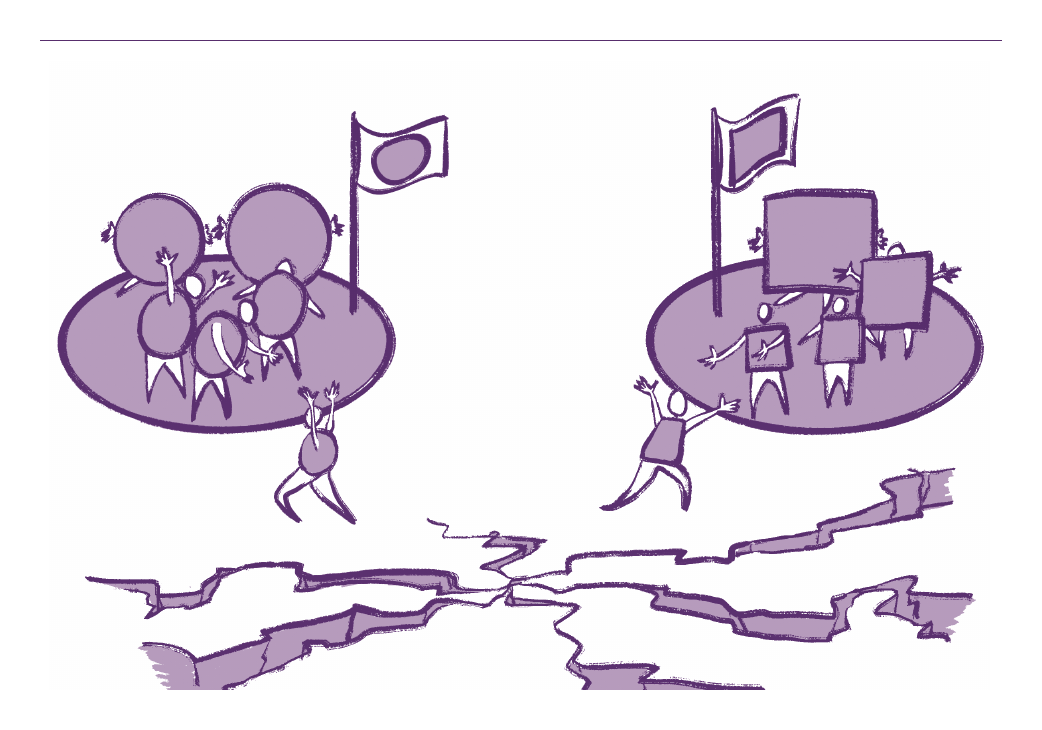
How extreme opposed positions can dominate a shared social landscape.
Source: Nurturing Hope, Conflict-Affected Cultures and Societies, May 22 Final The Understanding Conflict Trust - Nurturing Hope - 4 Conflict Affected Cultures and Societies.pdf, pages 37-41
SOME DYNAMICS OF CONFLICT-AFFECTED CULTURES AND SOCIETIES 5 DC5: EXTREME OPPOSED POSITIONS CAN DOMINATE THE LANDSCAPE
When we are secure as individuals our different experience traditions and cultures can be shared with different others and valued by them. The richness of our different lives is a potential gift to all. In such engagements we enhance the ‘common good’ through sharing:
-
the experiences we have, of work and leisure, hope and hurt, ability and disability;
-
our skills, talents and different interests;
-
our experiences, languages, cultures, education;
-
the places we have travelled to and come from;
-
the gift of unexpected stories and connections.
The philosopher and economist, Amartya Sen, speaks of us belonging to only one race, ‘the human race’, and that we are people having ‘diverse diversities’. This means that even when we identify with some specific different identities-an interest, pursuit or culture-not only are these differences diverse, but, within them, there is a wide range of different views and opinions. Looking at the diagram, there are no ‘good people’ and no ‘extreme people’ .
Each one of us is capable of being ‘good’ and being ‘extreme’ , and all the points between! Without deep relationships with different others that hold us together, fears and anxieties can readily dominate us. We experience moving away from one another and taking up positions that are more extreme, often excluding different others! In such a separating climate we can begin to think that there are no ‘different others’ worth meeting, or whom we might be able to trust.
We imbibe a pessimistic common sense that erodes many opportunities to promote more hopeful meetings with different others around us. xiv An Initial Encounter across Opposed Traditions “Why were there places some people did not feel able to go?” In a first meeting together some Northern Irish people wished to look at the divisions in their own town. This turned into a discussion with many surprises.
Some were surprised to hear that others did not feel able to go to places they themselves frequented and were at ease in! People began to defend ‘their places’, not understanding the fear such places had for people from ‘the other side’. These included social places like discos, cafes etc. The group was invited to look at the areas of the town in which they felt comfortable and where they felt uncomfortable. They were asked to seek out some reasons why some areas were safe and others not so.
Gradually they saw how some of their views were not shaped by their actual experiences in these places. They were shaped by stories others had told them, stories linking the places with the ‘worst people’ on the other side. They had accepted them as being true. In conflict-affected societies, the experiences of being on opposite sides of the line of fear and antagonism within the society are very different.
The emotional force field around one particular incident means that people on different sides will probably view that same incident very differently. It is essential that people from one background are sensitive to hearing the different, and sometimes difficult, experiences of those from a different background and vice versa. That can be a discomforting experience!
When people try to argue that some particular place is safe, even after being told that the other person feels threatened there, it is possible they will be seen by the other person as being on the side of those who threatened them. In the second meeting, after this initial encounter, different people spoke about some harsh experiences they had had on all sides of the fear/ antagonism line. The stories included actions by the police and paramilitary groups.
Some people spoke about having relatives in the police and feeling vulnerable. Others spoke about how difficult it was to stand up against people with paramilitary affiliations. Some others spoke of it being important to be able to go to local paramilitaries to sort things out because they did not trust the police. In the diverse group, people from all sides heard the struggles of those different to them, and how their relatives and friends could be provoked by different actions from ‘the other side’.
From these meetings people realised how so many people were, and are, oblivious of those they threatened, yet all were very sure who threatened them. In this new meeting space, the members of this group came to new understandings that could only happen through being with ‘the other’. Without such meetings and on-going engagement between them, they would not have realized that their images of the other were increasingly shaped by those who took a more extreme position.
Unless people meet and engage with one another, learning to trust, negotiate, create and live together, fears and uncertainties can fill the void between them. The appeal of those offering simple and more extreme separating views can grow without the human-relationship glue of ‘meeting together. ‘
DC5: EXTREME OPPOSED POSITIONS CAN DOMINATE THE LANDSCAPE
INVITATION
If you feel able to, please scribble some notes or write a longer diary type entry about how you respond to this dynamic in your own life.
REFLECT ON YOUR OWN
Have you been, or could you imagine being, in a situation where you, and others, became a little more fearful or uncertain? Have you ever spoken, or could you imagine finding yourself speaking, in a more hostile tone or beginning to express more extreme views? Have you, or someone you know, moved to a more hard line position, increasingly cutting (your/them) selves off from being with ‘different others’? In your real or imagined circumstances what are your underlying beliefs about the different others at this time?
Find Your Voice
In this section you may only want to reflect on the questions in private and that is fine. Have you ever had a significant relationship with someone from a different tradition or identity? What, if anything, was important about that relationship? Have you ever had the experience of siding with people espousing a more extreme position? Did the relationship you identified earlier, with someone different, affect your ability to hold a more extreme position?
Explore Your Reason
At that time, what was attractive about those holding a more extreme, separate, position? What safety did those holding a more extreme position offer you? Did you move towards that position and get more deeply embroiled in it? If you have never had such a relationship, try to find those people and relationships that gave you this freedom to be with different others?
Examine Your Choice
The emotional pull of taking up a more extreme position grows as we lose contact with different others and move towards those espousing more extreme positions. Recalling or imagining such a moment, did you recoil a little from it as you got closer to the extreme position, or did it suck you in? Did you stay in that position? If so what reasons did you develop for this? OR Did you recoil from this position? If so, what reasons did you develop for such a movement? Did any earlier friendship with a different other play a part in your response?
COLLABORATIVE ACTIVITY
If you are willing now, speak about the themes above with another person or in the group of which you are part. Hearing your own voice and the voices of others, what are you now learning about the experience of extreme positions so easily dominating relationships? Would you make the same choices now and why? Would you make a different choice now and why?
Summary
When there are few experiences of meeting the ‘different other’ in a society, the tendency, especially when there is a degree of anxiety, is to move towards those you are told share your beliefs and identity. Again, if there are few opportunities for people to engage with different others and populate the spaces between different people, those wishing to promote fears, or even more extreme views, have more influence. A culture of ‘Pessimistic Common Sense’ develops.
“There is no value in reaching out to the other” and there is no hope that things are going to be any different. The challenge is to encourage those who wish to speak out against the dominance of such views. In a conflict-affected society an act of violence often has a communal meaning and private acts of violence are rare. xvii Allowing uncertainty and fear to escalate is the graveyard of hope.