Conflict-Affected Cultures and Societies
DC 4 Separation, Avoidance And Politeness Or Meeting Together?
How separation, avoidance, politeness, and meeting together shape life across difference.
Source: Nurturing Hope, Conflict-Affected Cultures and Societies, May 22 Final The Understanding Conflict Trust - Nurturing Hope - 4 Conflict Affected Cultures and Societies.pdf, pages 22-36
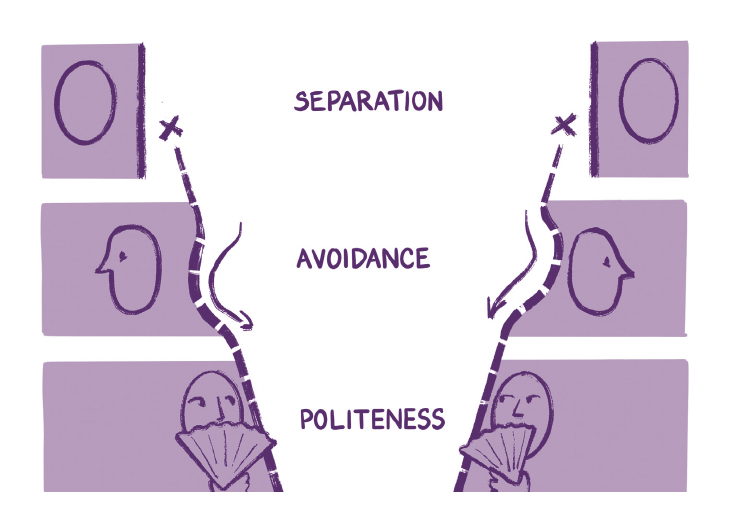
SOME DYNAMICS OF CONFLICT-AFFECTED CULTURES AND SOCIETIES 4 DC 4: SEPARATION, AVOIDANCE AND POLITENESS OR MEETING TOGETHER?
What is Cultural Common Sense? Often, in societies where fear and violence have been, or continue to be, real we find ways that ‘appear to lessen’ the threat of that fear or violence growing again. These ways of not upsetting a fragile peace are the cultural ‘common sense’ ways in which we. Try to get by with the other members of the competing groups or traditions living in one place. On the surface, these ways of coping are understood to be ways that do not generate more tension.
They appear to keep things as they are, ensuring minimum offence or disruption. More critically these ‘common sense’ ways of behaving do little to assist the society move forward in a more shared and interdependent manner. Three elements of such cultural common sense are separation, avoidance and politeness. Let us examine them in turn, referring to the diagram above.
“whatever you say, say nothing!” It is the case that in societies where there are deep and unacknowledged issues, habits of separation, avoidance and politeness are a reality. These ways are usually not formally acknowledged or discussed between different people, they are just the ways things work! In Northern Ireland the phrase for this activity is, “whatever you say, say nothing!” These experiences of daily life together mean that:
-
social capital between citizens is very low.
-
levels of trust between different citizens are difficult to establish.
-
openness between people, essential to nurturing creativity and imagination in social, economic, cultural, faith, inter-faith and political life, disappears.
Some of us, especially those touched by threat or violence from different others, may well have good reason for keeping our distance. Our Challenge is: to dissolve old ways that just keep the lid on things between us, to break taboos and take the risk of meeting together!
In an uncertain, fearful, or antagonistic atmosphere, the cultural norms of wishing to remain separate, avoid, and be polite, when in the presence of the ‘different other’, dominate. Such cultural ‘common sense’ actions may ‘keep the peace’ yet they have personal and societal costs.
They lessen societal cohesion and, eventually, public safety and they leave only a small space for people to “meet together” across conflicting traditions. As our skill and sophistication grows in the ways of separation, avoidance and politeness, the experience of meeting together deeply, if it ever existed, diminishes further. Meeting together is a shallow habit, with little depth and traction established between us.
Frequently, in group discussions about why we pull back from making relationships with people from different traditions, people highlight how communal pressures get in their way and threaten new relationships being formed. Often in these discussions people speak about the communal traditions that have developed in their street, area or town about how ‘strangers’ are dealt with, and how contact between people from different traditions is looked upon.
Very often people speak about sanctions or constraints being placed on those who wish to meet the different other. For the rest of this unit we are going to look in-depth at separation, avoidance and politeness. To prepare you for exploring these ‘culturally good’ reasons for navigating communal rivalries, either on your own, or in a small group, we invite you to engage in the following exploration.
Recreated study diagram
From keeping apart to meeting together
DC 4 moves through four culturally familiar ways of handling difference: separation, avoidance, politeness, and the risk of meeting together.
-
DC 4.1 Separation Apart Distance is maintained. Contact with the different other is treated as something to avoid if possible.
-
DC 4.2 Avoidance Steering clear Shared space exists, but energy goes into steering clear and keeping contact shallow.
-
DC 4.3 Politeness Guarded contact People coexist and speak, while sensitive themes remain guarded and mostly unaddressed.
-
DC 4.4 Meeting together Taking the risk People take the risk of respectful engagement and make enough room for trust to begin.
DC4.1: CULTURAL GOOD REASON- REMAINING SEPARATE

Separation is: I actively try to remain separate, out of all contact, if at all possible with those different to me. Separation means that we stay away from the many different places and spaces where ‘the others’ might be. Separation can be costly, although when we seek it we see it as a safer way to be. We develop cultural common sense arguments in support of maintaining ‘ourselves alone!’
Some of us, understandably, believe we have good reasons to remain separate from different others, at all costs, because of previous hurts we, or family members or friends, have experienced at the hands of ‘others’ . Others, with less good reason, still settle for remaining separate without thinking too much about it. Some of us speak about experiencing communal pressures to remain separate from others or else “face the consequences” of not being trusted or liked by our side!
Are there limits to remaining separate in today’s interdependent world? In today’s interdependent world of work, leisure, study, travel and the challenge of experiencing a pandemic as well as the global challenge of securing the environment for future generations there are real costs to remaining separate from different othersxv. Separation “In our town center, if you’re young and male, you know not to walk on the side of the street that does not belong to your tradition.
There are shops we identify as belonging to ‘one side’ or ‘the other’ and you stick to them. A boy got his head split open when he walked on the wrong side, a gang of other boys smashed a hardware shop window, took a large wooden shaft from it, and proceeded to lay into him with it. Any outsiders found on the wrong side often get beaten up.” Here, members of each tradition associated with different gangs, maintained a strict territorial separation.
They may even occasionally provoke some of ‘the others’ by invading ‘their territory’ in the town center just to test out, and assert, the existence of the separate boundaries. For some, this communal rivalry and separation extended into the center of the town. If one group’s territory was invaded, the need to maintain strict separation led to frantic attempts to drive the other away.
DC4.1 CULTURAL GOOD REASON- REMAINING SEPARATE
INVITATION
If you feel able to, please scribble some notes or write a longer diary type entry about your responses to this relationship type.
REFLECT ON YOUR OWN
You are invited to read the following statements from someone who wishes to remain separate from others different to them. Examine your response to the statements. “I do not see any need to spend time with you or your like. In so far as is humanly possible, I will never allow myself to be in your company. I do not wish to hear your views. I will try my outmost to live apart from you and never deal with you at all.” “I do not see remaining separate from you as a cost.
I do not see it limiting my experience or contacts because I enjoy my own company and the company of those close to me. I enjoy arranging my days so that I am self-sufficient or with like- minded people. I am even prepared to limit the places I can seek work, shop or follow a hobby. It is a small price to pay!”
Find Your Voice
Put yourself into the role of the speaker. For now, give yourself permission to be that person. Imagine buying into the above statements. For you, what are the benefits of remaining strongly separate from different others? Do you think it is possible to live such a separate lifestyle at age 18? 25? 40? 50? 65 years plus? What is your response to the above strong, deeply held, views? Coming out of role for a moment: In terms of your current lifestyle, would it have any elements of living separately or none?
Explore Your Reason
Going back into a role of seeking to remain separate: What good reasons do you have for wishing to live separate from others? What would this mean for your existing friendships and maintaining your contacts? Coming out of role now: Do you think this way of living is wholly feasible in our interconnected age?
Examine Your Choice
Being yourself. If you were to choose to live in a pure and completely separate manner, what changes would you have to make? If you wished to live as separately as possible from different others, what would that mean for you?
COLLABORATIVE ACTIVITY
Coming to your own way of life today: If you are willing now, speak about the themes above with another person or in the group you are part of.
If you adopted this position now, what demands, if any, would a decision to remain separate from others, different to you, place on your current lifestyle? Hearing your own voice and the voices of others, what are you now learning about the experience and potential of such separated ways of living apart from different others? How feasible is it? How desirable is it? Are there any major difficulties in choosing this way of living separate from others?
Summary
Separation may involve cutting off opportunities to secure work, expand social contacts or widen sporting opportunities or cultural interests. Separation may mean that there are places where you never go, by passing opportunities and events in which you might have an interest. Separation may shape some people’s travel plans. They may not be willing to take some well- established routes and short cuts, adding to the time they spend travelling and the cost. For them, their talent and interests are contained within their own small group and their skills and insights are not shared with other people nearby.
DC 4.2: CULTURAL GOOD REASON- AVOIDANCE

Avoidance is: a pattern of ‘steering clear of different others’ who are in my vicinity for living, work, study and other reasons. Avoidance means I show them the minimum acknowledgement demanded. I spend a lot of energy avoiding different often. “I just never have experienced them showing me respect and yet we have to be in the same place on many different occasions. To be honest “avoidance’ keeps the peace. I just do not like them!”
“At least by avoiding one another, everyone knows that nothing physically damaging will happen between us.” Avoidance, when sharing the same place with different others, means that any contact there has to be is extreamely limited. There are no topics on which you are prepared to engage with them. It means that: you are always on the lookout for ‘them’. You never acknowledge them.
You are always moving on, seeking safety with like- minded people, never being trapped in the company of different others Avoidance means that you put no energy into relationships with others different to you, it means that you possibly by-pass some opportunities, and you are prepared to pay that price. Avoidance can, at certain times, be a way of not responding to rivalry—not adding to the emotional mess.
Avoidance in such a manner may have some value in de-escalating conflict although it, in no way, contributes to the conflict being addressed and resolved.
INVITATION
If you feel able to, please scribble some notes or write a longer diary type entry about your responses to this relationship type.
REFLECT ON YOUR OWN
You are invited to read the following statement from someone who wishes to unashamedly avoid others different to them. Examine your response to them. “I acknowledge that inevitably I have to sometimes be in your vicinity, but I will keep any contact to a minimum.” “I acknowledge your right to exist but find it difficult to show you respect.”
INVITATION
TO EXPLORE Put yourself into the role of a person whose main task in daily life is to avoid being in the company of those who have a different identity, belief, background or other distinguishing characteristic. Imagine yourself buying into the above statements. Remaining in role:
REFLECT ON YOUR OWN
Find Your Voice
How do you feel coming into diverse company? Staying in role, what do you continually think about, spending all your time avoiding different others, yet having to be in their company? In role, you still have to go out to places where different others will be. In those situations what do you need to be always aware of so that you avoid them?
Explore Your Reason
What good reasons might lie behind your wish to avoid different others? A pattern of avoidance can influence where you prefer to shop, the times you shop, the public spaces you visit and many other considerations. “I prefer to be with my own at all times and I am even prepared to withdraw from invites if those others are going to be there. If I do end up in their presence, I make myself very invisible!” What are the costs to a person who is unashamedly avoiding different others?
Examine Your Choice
Staying in role: What good reasons do you have to avoid different others? Do your choices to avoid others, today, have to continue forever into the future? How might that choice be changed for you? What conditions would need to be satisfied? Can you build a more open and shared society if so many like you wish to continue avoiding different others?
COLLABORATIVE ACTIVITY
Coming out of role now: If you are willing now, speak about the theme above with another person or in your group. Hearing your own voice and the voices of others, what are you now learning about the experience and the potential costs of continually avoiding different others? How feasible is it? How desirable is it? Does a culture of avoidance Nurture Hope?
Summary
Whether through anxiety, fear, shyness or deeply held views that the others will not be agreeable, those of us whose lives are dominated by a wish to avoid meeting different others have to summon considerable energy before we arrive at places we must attend. To be such a person, avoidance when in the presence of others, means there are few, if any, topics we are prepared to engage with different others about. Avoidance means that:
-
we are always on the lookout for others;
-
we never hang about much, always moving on, seeking safety wherever it might best be. Avoidance means that we put no energy into new relationships with others different to us, it means that possibly some opportunities pass us by. When with different others, avoidance means that any contact there has to be is limited and shallow. To avoid having relationships with different others means that we take good care to know whether they will be there and what options you will have to avoid having to spend time with them. Avoidance can offer the illusion of ease yet it can be so intense!
DC 4.3 CULTURAL GOOD REASON- POLITENESS
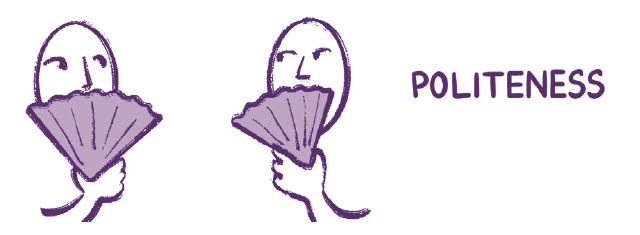
Politeness is: how we behave when we must share the same space, event or task with ‘different others’ and do not wish to meet them at any significant level. To be polite means that there are no substantive themes or issues explored when we have to meet and speak; that issues of an emotional or antagonistic nature are not acknowledged and mostly do not emerge, although they are always under the surface. Politeness means that we talk about non-contentious items and never engage deeply. A study in being polite?
“In work I am in the midst of ‘different others’ and I only want the minimum engagement with them. This is exhausting. I am on constant guard, a state of uncertainty, because the last thing I want to happen is that I get embroiled in a discussion that I do not wish, or know how to act appropriately in.” This quote illustrates the sadness and tension that can accompany many people who, very reluctantly, work with different others and survive by politeness!
“There are many times where we have to be with ‘them’ in order to progress business ideas or arrange community events that we all have to be part of. We have established a polite way of getting the business done. There is no chatter or gossip between us, we just go in and do the business. We do not share any pleasantries; it is all very formal and polite!” Here being polite is exhausting and a perpetual state of nervousness.
People are always worried that they will get caught up in some emotional encounter that they will not be able to negotiate. “In our town everyone knows about everyone else, on all sides. It is too small to be otherwise. The population of the town, and its immediate area, is very evenly balanced between different identities. There have been threatening incidents in the town between the traditions but there is a silence about who did it, even though, within each group, people often know who committed the actions.”
Here, politeness is aided by a communal knowledge that violence is close to the surface so that people agree not to talk about it, hoping to live together without any major explosions of emotion. The communal politeness ritualises the tension and makes it manageable locally, so all remains in an uneasy, polite, peace. It does little to hold people accountable for threatening actions.
DC 4.3 AN EXPERIENCE IN BEING POLITE.
INVITATION
If you feel able to, please scribble some notes or write a longer diary type entry about your responses to being polite. EXPLORE Put yourself into the role of a person who needs to be with, and even work with, different others, and yet, for whatever reasons, wishes to only be polite. You have no interest in engaging in sensitive discussions or any sort of robust discussion.
REFLECT ON YOUR OWN
Imagine yourself being that person, living and working politely with different others whom you have to be with. Take time to get in touch with the statement below. “I recognize that we all have to be in the one space and work together and that there is no way round that. Begrudgingly I acknowledge your right to be there but any necessary contact between us will be polite rather than substantial and engaged. Conversation between us, if it has to happen, will be guarded and superficial. I will participate in as much as I have to, without expressing any serious opinions or views. I will skate around any sensitive issues and do my best to get out and away at the earliest moment.
Find Your Voice
Getting into this person’s behavior of needing to be with different others yet, for whatever reasons, wishing to only be polite and not engage in sensitive or robust discussion, how do you feel? and what are you thinking about? In what ways do you imagine being polite with different others in this place would mean? Coming out of role: Can you gain any empathy for people in this situation?
Explore Your Reason
From where do those of us who live politely with others get our cues to do so? Do we send out those messages ourselves? Is it a message our culture gives us? Or is it a more common culture in diverse settings that we are prepared to acknowledge? If it is more common throughout society: What benefit does society get from this behavior? What are the limits politeness places on daily life and our life together as a society?
Examine Your Choice
Do you believe that the people who speak in the examples above have good reason to choose the way of politeness? Are there any other choices open to them? If so, what are the costs of choosing them? Why should they?
COLLABORATIVE ACTIVITY
-
What have you learned about politeness in your own life?
-
If you have been polite on occasions, what lay behind behaving in this way?
-
Did you benefit from this way of being with others?
-
Where or when do you think you learned to behave in this way?
-
Are there any costs? For you? For the people you are with?
-
How, if people wished, would you and others acknowledge this technique and break it?
-
What and who would need to change for this to happen?
Summary
Politeness can be exhausting. You are in the midst of different others and you only want the absolutely minimum engagement with them. You are on constant guard, or in a state of uncertainty, because the last thing you want to happen is that you get embroiled in a discussion that you do not wish to have or know how to act appropriately in. Politeness means that you spend a lot of time skating around sensitive or emotional areas of discussion. You offer no opinions or views. All your conversations seek to keep the peace. All engagement is devoid of any personal sentiment or fellow feeling or common purpose. The acceptable cost of politeness is that some might be seen as being ‘a little bit light, intellectually and emotionally’!
DC 4.4: MEETING TOGETHER—TAKING THE RISK, MEETING AND ENGAGING
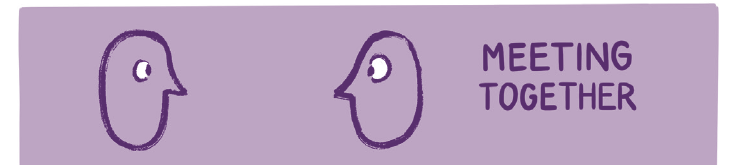
Meeting Together is: Taking the risk of engaging with the ‘different other’ respectfully, making ourselves a little vulnerable, as all initially may be uncertain. To ‘meet together’ is risky. Yet, surprisingly, many people in insecure societies, notably many victims and survivors and some former protagonists, have taken, and take, such risks.
When we do so we model hope-filled ways of being together, enabling some people to move on together, in spite of fear and antagonism. In some societies where there has been a history of conflict and division, some people and groups have met one another across the historically opposed traditions. In such experiences people and groups signal that a more restorative, reconciling history, for some people, is possible to imagine and work for.
Such experiences between people often draw on a mix of political, cultural and religious beliefs that support meeting ‘different others’ that conflicted societies tend to dismiss. Such people and groups nurture hope. If people are to experience new possibilities with one another that go beyond fear and distrust, any opportunities to gather in commonly owned spaces, and to connect across historic divisions, are very fragile yet important Opponents of such meetings dismiss them as false and engineered.
False many are not, engineered perhaps, because without some new events or experiences of being together separation, avoidance and politeness will continue to embed division, fear and distrust between people on different sides of the lines of fear and antagonism. In Meeting Together we look at the impact people from different historical traditions, religious and cultural beliefs, make when they take the risk of engaging with the ‘different other’ respectfully.
In such meetings each of us makes ourselves a little vulnerable, as all initially may be uncertain. There are risks that people may be offended or made fearful again and, also the risk that people will relax and enjoy one another’s company! In these materials we are not saying that some ways are good and others bad. We always have ‘cultural good reason’xii for the choices we make.
However, the direction taken within the materialsxiii is to invite those of us who have, or seek, freedom, to risk meeting the different other.
We are always free to question this model and find good reasons to reject it. In the experience of the authors, when we explore this model, most of us get a possibility to understand our experience of being with different others in a new manner. In groups where we explore the value of meeting together with different others, new insights often do come to those seeking ways beyond distrust and fear.
The purpose of meeting together is to move us away from relationships of rivalry and struggle and to share those experiences that are important for us. In a conflict-affected society meetings between people who are open to addressing the challenges of establishing meetings and practices between people from historically very opposed positions often have an emotional charge associated with them, including fear.
The emotions associated with the conflict in such societies are always near the surface and many people are uneasy and often unprepared for this experience. However when such groups address the issues and emotions that arise between them constructively, coming from the different traditions as equal citizens, they can have experiences where they are at ease. Such experiences can allow new understandings to develop between them.
It is our experience that these realities can also dominate professional groups concerned with social welfare, education, health or employment issues. In conflict-affected societies so many people may choose silence, politeness, and avoidance within their daily work life. To take the risk of ‘meeting together’ is to explore whether new possibilities exist together, beyond these separating dynamics.
To establish joint meetings with people who have traditionally looked after the needs of one tradition only, such as teachers in schools or faith leaders, and to invite them to explore what cross-community contact means, has often been to move into a very emotional atmosphere. Many people still believe that in taking the risk of moving out beyond their own traditional group and culture, the experience will provoke more fear and confusion.
People are often temporally mimetic with past experiences of having ‘cultural good reason’ to fear or be suspicious of the other. However, in an open atmosphere over many years, the evidence is accumulating that where people meet together and experience freedom together, they can draw on, and be spatially mimetic with trust and freedom. xvi
DC 4.4: MEETING TOGETHER-TAKING THE RISK OF MEETING AND ENGAGING.
INVITATION
If you feel able, please scribble some notes or write a longer diary type entry about your responses to this theme of ‘meeting together’.
REFLECT ON YOUR OWN
Frequently group discussions about why we pull back from making relationships with people from traditions different to our own, highlight the communal pressures that threaten the formation of any new relationships. Can you recall an experience where you, or someone you know or heard of, took a risk in a relationship and met with someone who was formerly their enemy?
Find Your Voice
To meet people you have been told to distrust or fear, is to take a risk. What risks, if any, might you face if you met people from very different identities and traditions? Are there any people associated with different identities or traditions that, at this moment, you would be hesitant about meeting? Try to gather some of the reasons for this hesitation. In your experience have there been people you have been brought up to distrust, yet now you have met and enjoy their company? How were such meetings secured and what difference have they made to you?
Explore Your Reason
You may not experience any difficulty meeting people from different backgrounds and traditions. If so, this is a wonderful freedom to experience. OR You might have good cause to hold back from taking the risk of meeting. Without judging or condemning others, can you list some reasons why you do not feel able to meet people from different backgrounds or traditions? What good reasons are there, if any, to support the importance of you meeting people you have been brought up separate from?
What good reasons are there to bring people from different identities together where you live? Some people have experiences of hurt being done to them by people from other traditions and identities. How might meeting some people from these other traditions be promoted and who might facilitate this?
Explore Your Choice
What makes it difficult for you to choose ‘Meeting Together’ rather than the ways of Separation, Avoidance or Politeness? How could meeting together become a common sense way of behaving in society? If people are willing to meet together, what are the implications for the ways we live as one society?
COLLABORATIVE ACTIVITY
If you are willing, speak about these themes with another person or in the group. Meet together, hear the stories of others, and tell your own stories of meeting others. Often in discussions people identify community traditions in their area about how strangers are dealt with. Often people identify personal or social sanctions placed on them when they meet ‘the different other’. Have you met different others and faced sanctions? To meet together is a risk, yet many have done this and moved on.
-
What different experiences have you had of meeting together with those you have lived apart from?
-
Have these experiences become common place now between you even friendships or is this experience still an exception? Hearing your own voice and the voices of others, what are you now learning about the experience and potential of such shared relationships?
Summary
“We are citizens of one place and members of the human race! We need one another to build a more open and safe society and wider world for ourselves, our children, grandchildren, nephews and nieces. The world needs people to make relationships between people where none have previously existed or where they have been broken. I see ‘meeting together’ as an essential human task.” (Sen) “To be free to meet and work and play with people from very different traditions and backgrounds is, eventually, to make communities and societies safer” “There are human and societal costs when so much time is spent apart. We lose trust. We reduce our collective creativity and imagination that could enhance social and economic life.”