Conflict-Affected Cultures and Societies
DC 3 Stay With Your Own - Them And Us
How fear and distrust turn staying with your own into cultural common sense.
Source: Nurturing Hope, Conflict-Affected Cultures and Societies, May 22 Final The Understanding Conflict Trust - Nurturing Hope - 4 Conflict Affected Cultures and Societies.pdf, pages 15-21
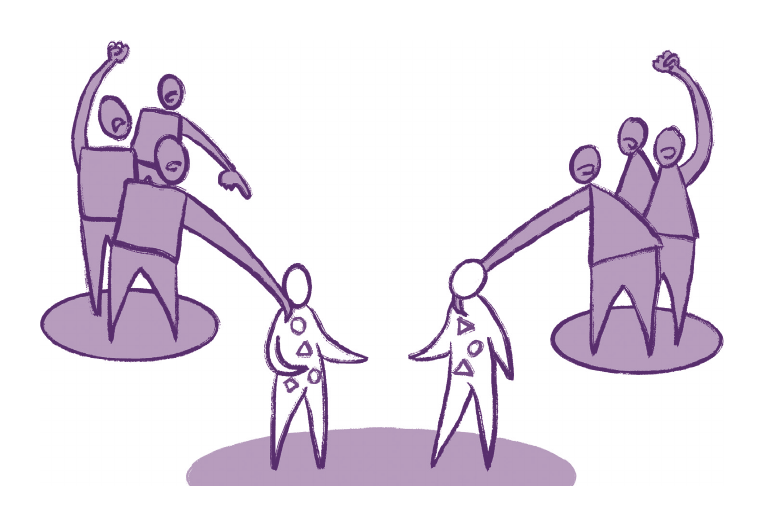
SOME DYNAMICS OF CONFLICT-AFFECTED CULTURES AND SOCIETIES 3 DC3: STAY WITH YOUR OWN-THEM AND US
If we have been brought up within a culture where there is distrust and fear of ‘certain others’ in our midst, we tend to have few trusting relationships with those others! Where such a relationship with a ‘different other’ might exist, through some family or friendship connection, the relationship tends to be very tentative and always fragile, because there is limited social and cultural support for it. When we do not live in a culture of strong relationships connecting us across social, political and cultural differences, the distance between us can grow ‘in a flash’ and fears can quickly escalate. The tendency is to grow apart.
”STAY WITH YOUR OWN” BECOMES CULTURAL COMMON SENSE
In the presence of fear, and in the absence of any deep trusting relationships with those who are different, we can come to perceive ‘the other’ as a threat. We more readily move towards those we think that we are like and away from those we are told are different to us. The dynamics of ‘stay with your own’ and ‘them and us’ more readily mobilise us to congregate with those we believe are like ourselves, and stay away from those we believe are different to us.
It appears to make cultural common sense, apparently offering us a greater sense of security and protection3. Within a distinct ‘us or them’ society, the identity of being equal citizens is eroded, if it ever existed. The freedom to be diverse individual citizens becomes hostage to the need to belong to a distinct cultural group and accept group norms that exclude the others. Increasingly each one of ‘us’ becomes more dependent on the group for so many aspects of our life and the choices we make or cannot make.
“Stay with your own” appears to give safety.
INDIVIDUAL ACTS OF AGGRESSION ARE TOO EASILY INTERPRETED AS REPRESENTATIVE ACTS OF VIOLENCE ON BEHALF OF THE OPPOSED GROUP
In insecure situations, conflicts between individuals are too readily experienced or understood to be conflicts between opposed identity groups. When fears are rising, intimidating actions or violence by one person against another is not just understood as an individual act of aggression. Each individual act is too easily understood as a representative action on behalf of one group against all members of an opposed group. Representative conflicts escalate readily.
‘THEM AND US’ STRENGTHENS: TRAITORS ARE IDENTIFIED As relationships between us dissolve, the space between us can be readily filled with rivalry and conflict. In such escalating rivalry we lose sight of one another’s name, family, hopes and fears and, too readily, generate feelings of ‘us and them’, ‘for and against’. Such dynamics de-humanise us!
Within strengthening and increasingly opposed identities, each group develops myths, rituals and behaviors about how they view ‘the others’, with very little internal challenge. When some members express a willingness to be open to meet ‘the other’, they are often called ‘suspect’ and even identified as ‘traitors’. The cultural ways of each group generate good reasons to stay apart. 3 We are more characterized by ‘communities of entanglement than communities of association!’
See Sandel ,The Procedural Republic and the Unencumbered Self Political Theory, Vol. 12, No. 1 (Feb. , 1984), pp. 81-96
’THEM’ AND ‘US’ BUILDS OPPOSITIONS: ESTABLISHING THE BOUNDARY
Specific areas or places can become boundaries associated with conflicts between diverse traditions. Territory markers such as bridges, cross roads or parks can become boundaries, often associated with identity rituals or ‘mock fights’. ‘Peace walls’ between distinct identity communities are such boundary markers.
People involved in conflicts often use specific locations, places of cultural significance or choose days and dates of significance to mobilise wider support and build solidarity within groups and establish boundaries. When fears are high, people understandably seek to mobiise some others as ‘allies’ and some locations as ‘theirs’. Such places can become places where ‘proxies’ for opposed traditions can do battle on behalf of the wider interestsxiv.
‘Them and Us’ dynamics establish hard boundaries where defensive positions can be secured and maintained. Places associated with stories of solidarity and identity are sought out as spaces to return to and memorialise.
THE DIASPORA FACTOR: CONFLICTS CAN MAGNETISE OUTSIDERS
The diaspora of identity communities are those living, near and far away, who can be counted on for support. Local conflicts can become places where, at a distance, an additional large mass of diaspora support can be mobilised and drawn on against the ‘others’. Escalating conflicts even have the capacity to draw in those who would prefer to stay distant. In an escalating conflict even those diaspora members who may not want to be involved at all can find it difficult to stay on the sidelines. Conflicts have the capacity of using all available personal, physical and cultural differences to support one side, as these examples illustrate.
-
Schools can become locations associated with, and provide a focus for, identify conflict, regrettably.
-
Faith traditions can be used to justify religious fights rather than promote inclusion and acceptance.
-
Faith related buildings can become locations where one tradition is accepted but others are not.
-
Professionals can implicitly align themselves with different sides, even when they seek to remain professionally above the conflict. In a conflict, different bodies can be perceived to be under partisan political control, yet public bodies should be impartial, serving the needs of all. Civic leaders in a conflict can readily be seen as pro-or anti- specific sides.
CONFLICTS GENERATE FEELINGS AND MOBILISE SUPPORT: SYMBOLS AND MARKERS
In old culture flags were defended fiercely. The flag, in one sense, was a lightning conductor for emotions associated with the heart of a people or an army’s identity. Conflicts between people are dynamic events where each side seeks to win. Conflicts between traditions or ethnic identities bring much to the battle-flags, histories, memories, symbols, rituals, and hurts. Symbols and flags emphasise territory and boundaries. There may well be wider attempts to claim or colonise all available markers to add to the strength of the different identities. These can include different sporting teams, music and song, certain dress codes and specific languages.
TERRITORY IS CLAIMED
‘Us and Them’ very readily become aligned with specific territories or places where the control of the different groups are marked out. Attendance at ritual events are often associated with specific places and failures to attend such rituals are noted.
DIFFERENT AND TOGETHER
For those of us with family histories that are more complex and diverse, such as having relationships and relatives from different traditions, it is especially difficult. In a ‘them and us’, ‘stay with your own’ dominated culture, such different linkages so often have to be hidden or denied, and yet they are often more numerous than is publicly acknowledged.
The pressure to ‘stay with your own’, when your family history actually includes some ‘different others’, often demands that people keep silent about this more complex family reality. It may become impossible to openly speak about this within our own cultural group. Where such mixed tradition, cross- connecting families or friendships do exist, these very people are best able to understand what it means to live beyond identity domination and a ‘them and us’ culture.
Such a mixed, cross-connecting, relationships are the very experiences and knowledge ‘them and us’ dominated societies need, if these societies are to eventually become more open, welcoming and inclusive.
DC3: STAY WITH YOUR OWN-THEM AND US
INVITATION
TO EXPLORE If you feel able to, please make some notes or write a diary entry about how it felt for you within a Stay with Your Own-Them and Us Dynamic.
REFLECT ON OUR OWN
Recall a situation in your street, school, neighborhood or town where you and your friends split into two opposed groups and the stand off was heated and lasted for some time. This conflict may even have divided your friendships and led to fights about which group was the best to belong to! If you cannot recall such a situation imagine one.
Find Your Voice
In this stand off, thinking back, what drove you to move towards the particular group you joined? Did this happen because of a history of differences between the groups or was it decided in a flash? What caused the movement into opposed groups?
-
Was it loyalty to one person?
-
Was it responding to a wider culture of distrust?
-
Was it a principled disagreement?
-
Are you now not sure what it was about but just remember a lot of anger and emotion? What was the outcome?
-
How were ‘the others’ spoken about in your group?
-
Do remnants of that experience still shape your relationships today?
-
Is it all a distant memory that you are now better out of?
Explore Your Reason
Consider how and why you, or others, settled for living in the way you identified above?
-
What good reasons did people give for doing so?
-
What were the reasons, abilities, strengths or attributes that each side used in its defence in the escalating row? What security did moving into one group offer you?
-
Did it last? If not, how did it dissolve?
Examine Your Choice
It is understandable that, when we are uncertain or fearful, we gravitate to those we think we are like and away from those who are different to us. What would it cost you then to have reached out to those who were identified as ‘them’? How would members of your own group have viewed any reaching out to the others? How do you think the others would have responded to this? How easy or difficult would it be for you now, if you were in that position, to choose to change or dissolve these old ways? What would be the possible impact, if you succeeded, for yourself and for your relationships with those previously involved with as ‘us?’ What might be the possible scenarios if you took this step:
-
With your newfound friends?
-
With your old friends?
-
With your family?
-
In your society?
COLLABORATIVE ACTIVITY
If you are willing now, speak about the themes above with another person or in the group you are part of. Having heard your own voice and the voices of others, what are you now learning about the experience and potential of such ‘stay with your own’-‘them and us’ relationships?‘
Summary
As a conflict escalates the different abilities and interests that enrich our life together get used up. In the escalating fight we use our differences of numbers, wealth, language, strength, culture, power and much more to support our arguments, strengthen our base and gain some advantage. (See Understanding Relationships) The primary identifier for democratic societies is an individual one, that of being a citizen.
Societies that are primarily organised around ‘them and us’-communal identities-are less stable and more controlling of the actions of individuals. Often the reason we put communal identity before shared citizenship is that we do not feel individually secure and safe. When communal identities dominate a society, threat and violence can even more readily be justified and generated.
It is very important that citizens, public institutions and wider civic systems give a priority to creating just and peaceful civic norms and dissolve the ease with which a more conflicted society generates ‘us’ and ‘them’. Societies where communal identities dominate social relations do not guarantee each citizen their place. Such societies face the challenge of embedding more open, agreed, and fair public institutions, underpinned by equitable treatment and basic human rights.
When such minimum standards are generated, people can then choose to develop new commitments to live together well.