Understanding Relationships
RD 1 All Against One - The Victim Pays
How scapegoating isolates one person or group while restoring order for others.
Source: Nurturing Hope, Understanding Relationships, May 22 Final The Understanding Conflict Trust - Nurturing Hope - 3 Understanding Relationships.pdf, pages 9-16
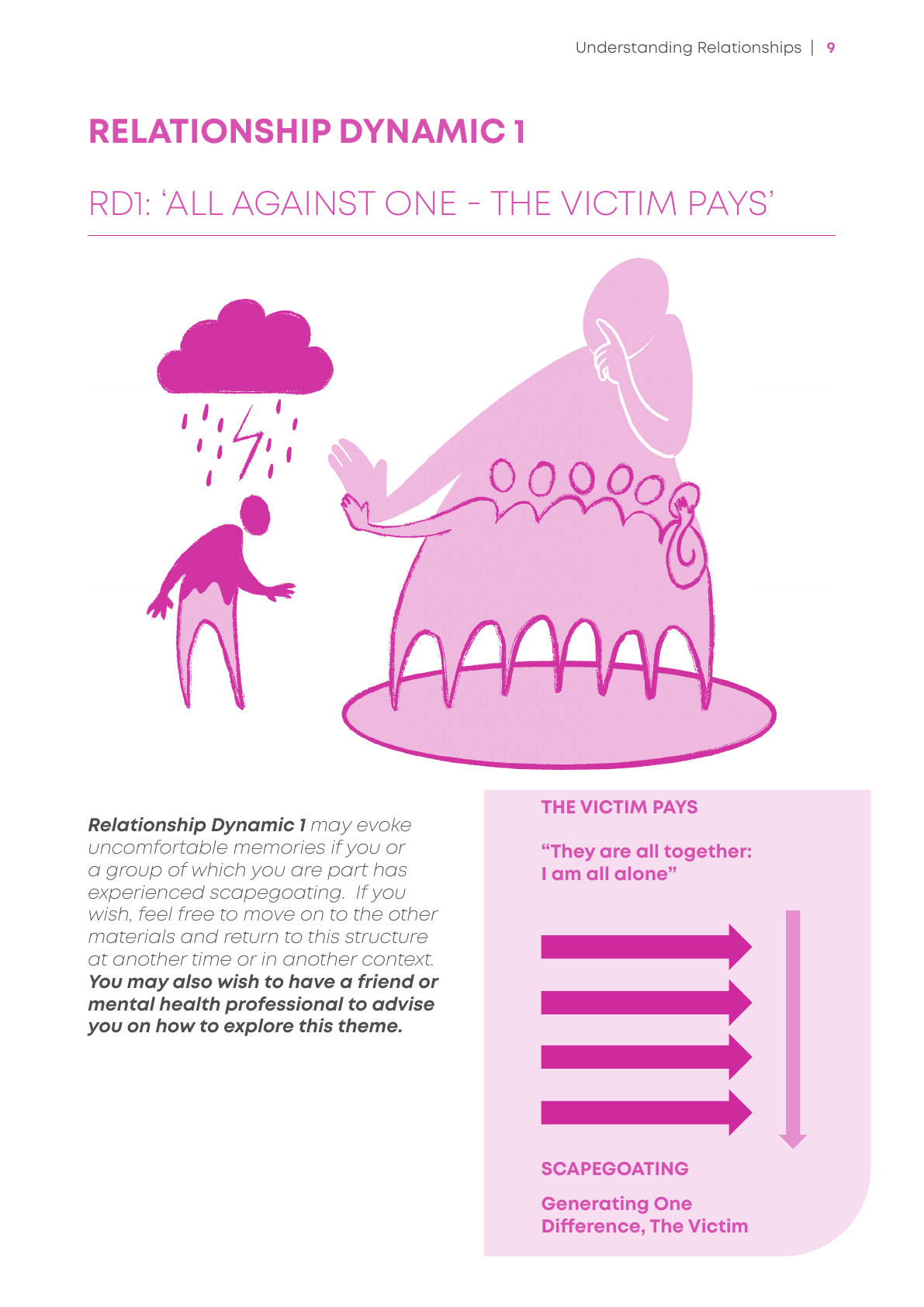
RELATIONSHIP DYNAMIC 1 RD1: ‘ALL AGAINST ONE - THE VICTIM PAYS’
Relationship Dynamic 1 may evoke uncomfortable memories if you or a group of which you are part has experienced scapegoating. If you wish, feel free to move on to the other materials and return to this structure at another time or in another context. You may also wish to have a friend or mental health professional to advise you on how to explore this theme.
THE VICTIM PAYS
“They are all together: I am all alone”
SCAPEGOATING Generating One Difference, The Victim
Referring to the associated set of diagrams, a short description of the elements and phases of scapegoating within a group are outlined. Please try to get into the emotions of such dynamics, perhaps drawing on a bullying incident you witnessed, or even were part of!
Phases of scapegoating within a group
-
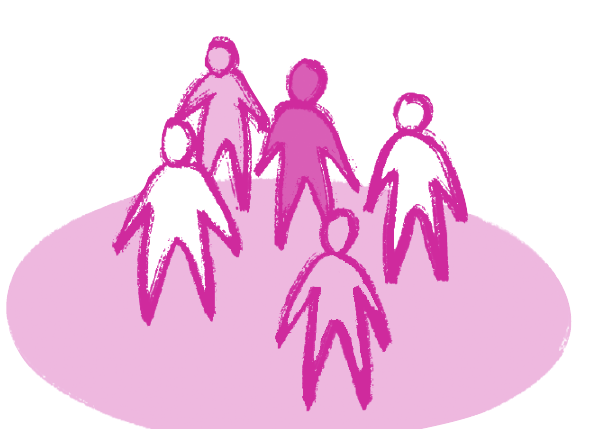
Phase 1
We are all together and different
We belong together.
-
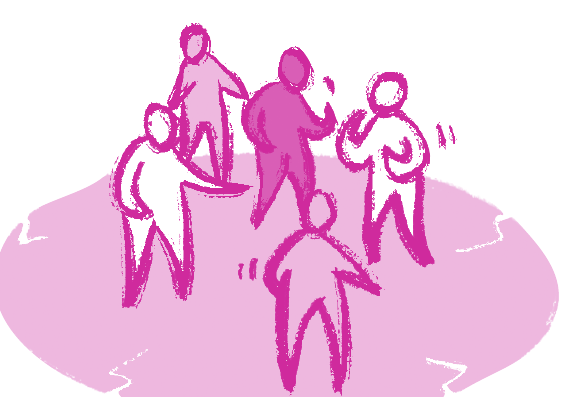
Phase 2
We become unsettled
For some reason.
-
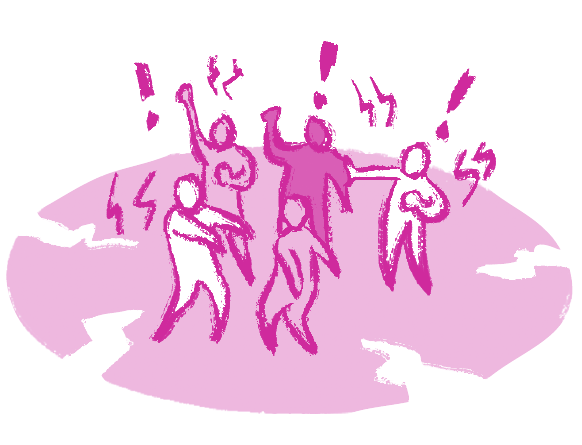
Phase 3
People increasingly interfere with one another's space
We experience things becoming less secure.
-
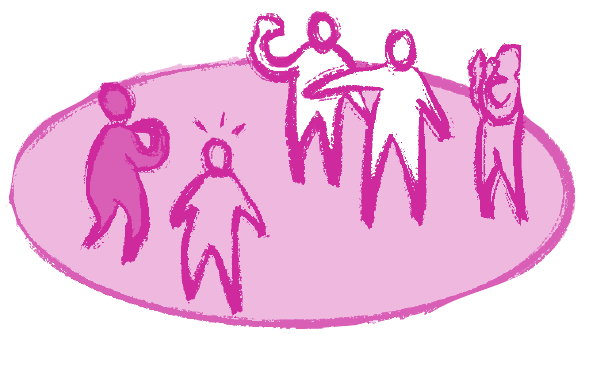
Phase 4
The impulse of 'the many against some' grows stronger
To secure a steadier order, individual differences dissolve, oppositional groups form.
-
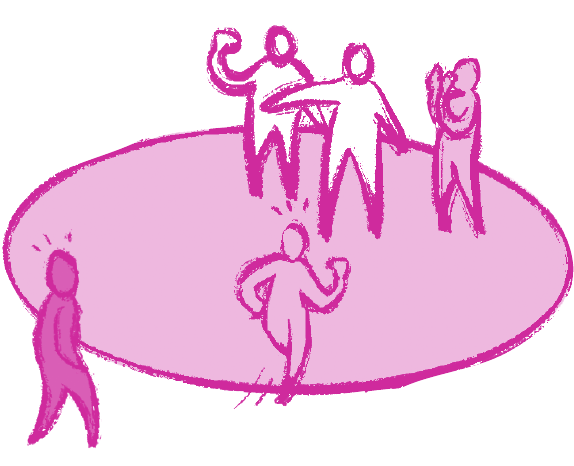
Phase 5
The dynamic of "all against one" develops
In a twinkling of an eye, some of us appear to coalesce and isolate an 'other', on whom the badge of threat or difference can be placed.
-
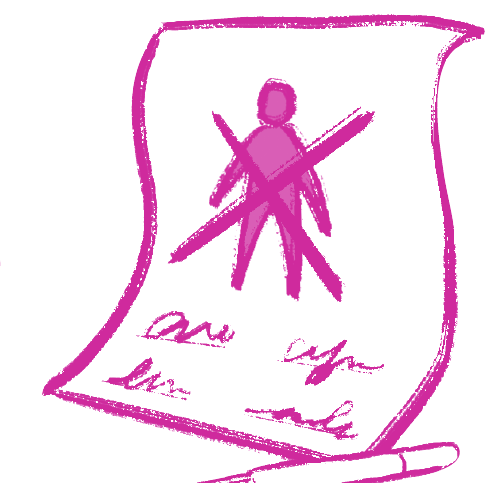
Phase 6
'Us' versus 'the one who is not us' is secured
We unite over and against another, who we then drive out. We are all agreed, they are the cause. However the scapegoat is never responsible for the chaos that leads to their expulsion.
-
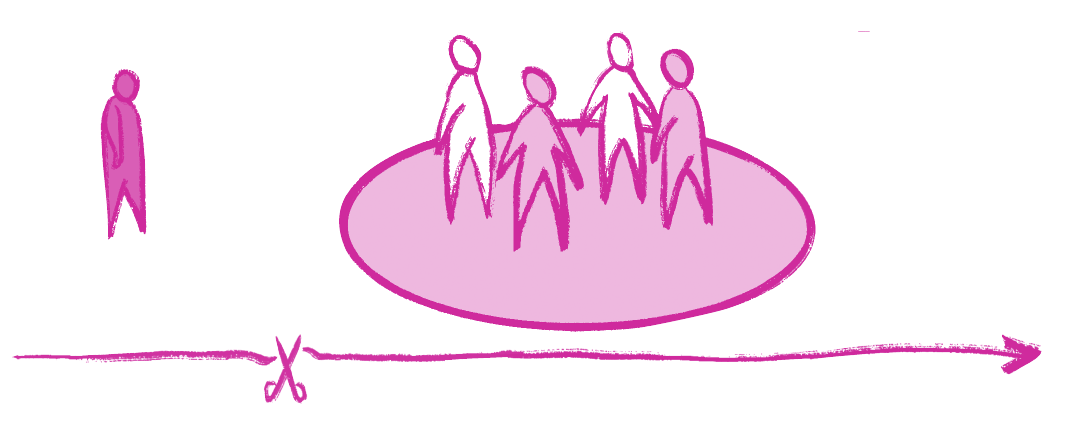
Phase 7
Order is established, for a while
Those who remain, secure a peace 'of sorts'. Stories or myths develop about this peace and how 'we will be together as friends or associates, over and against other threats'. The victim is only spoken about in past terms. The order resulting from the scapegoat is secure only as long as the violence against the scapegoat is never spoken about.
RD1: ‘ALL AGAINST ONE - THE VICTIM PAYS
Referring to the previous images the scapegoat mechanism progresses in phases, with a pattern of identifiable transitions. Joking, banter and ridicule can be the initial markers of scapegoating.
Phase 1: We are all together and different.
In the culture of many groups there are various degrees of what we in Ireland refer to as ‘joking’, ‘craic’, and ‘banter’. In the US there is ‘ribbing’, ‘picking on’, and ‘teasing’; in Korea it is ‘nolim’; in Japan it is ‘karakau’. At their mildest and least harmful, these are the ways in which a group defines itself through quips amongst friends, references to old experiences, gentle put-downs, well intended jokes and reminders of who is powerful or who thinks they are influential in the life of the group.
When group membership is well established and nurtured by robust and strong relationships, these actions are at the center of the group’s rituals. As a rule, as long as praise and insults are equally traded around members, all the members taking their turn to be ‘mocked’, the group probably remains together.
Phase 2. We become unsettled and uneasy.
When such comments start to become more personally hurtful, tending towards ridicule of the behaviors or attributes of one or two members in particular, this is a sign of emerging uncertainty within the group. The group ceases to be enjoyable when increasingly only one or two members are isolated or humiliated by the whole group. In such a moment the old assumptions about the group are no longer secure.
Phase 3. People increasingly interfere with one another’s space.
A group of people initially at ease with one another may now find that they are uneasy and maybe even anxious with one another. Some members increasingly interfere with the space and freedom of others and erode the group’s structure.
Phase 4. “The many against some grows stronger”
A sub-group of members align themselves and, in the uncertain atmosphere of the group, the many, often without realising it, gather more to their cause. Left unchecked, there is a growth in harsh joking and demeaning comments. Group discourse reflects a loss of respect for one another and each other’s feelings. Comments and group behavior begin to slip into expressions of ridicule and disdain. Caught in this process, members of the group may not even realise what is happening. The group begins to divide into ‘us’ and ‘them’.
Phase 5: The dynamic of “all against one ’ develops’
Unless checked, in ‘the twinkling of an eye’, the group dynamic subconsciously begins to divide into “us and them”. With a growing lack of structure, each member of the group searches for safety. Though not spoken about, this safety is generated by mobilising the unanimity of “all against one”. “The many”, acting with instantaneous agreement, identifies “the one” with some ‘alleged distinctive difference.‘
Phase 6. “Us’ versus “the one who is not us” is secured.
In a flash, the scapegoated person is identified, isolated and eventually excluded without any protectors. “I am all alone and they are all together” is now the experience of the scapegoated person. The scapegoat is never responsible for the chaos.
Phase 7. Order is established, for a while.
The scapegoat is driven out, isolated. For those who remain, they celebrate and there is no acknowledgement of what occurred. Over time stories and myths develop about that time in the history of the group, the violence never being acknowledged. Myths, histories, rituals evolve that all cover up the hidden violence of that action. Those who remain are silent and deny anything untoward happened.
CONCLUSION:
It is not just people in small groups of families and friends who scapegoat. It can also be part of the often unacknowledged history of organisations, competing identities, cultures, and national histories too. Those who are scapegoated are forgotten until, if they are fortunate and alive, someone stands with them and insists their stories are heard!
When the scapegoating process is ‘successful’ in restoring peace to a group, the threat of violence associated with it is never acknowledged by those who did the scapegoating. The truth about what happened remains hidden. This is why the dynamic needs to be exposed and more widely understood, if we are to nurture hope.
It is our shared responsibility to develop societal ways and means to challenge the prevalence of such abusive practices in private, public and civic life. The victims have already suffered enough; this is not a responsibility we can place on them alone.
Thankfully we live in times when it is more difficult to hide the actions and crimes related to scapegoating. More and more people are prepared to stand alongside those who have been or are being bullied, victimised or scapegoated. And yet, scapegoating persists. Continued reflections on the choices that contribute to it are required of us all.
In the sections that follow we use the term scapegoating to cover actions variously referred to as intimidation, victimisation and bullying. They all create dynamics in which people:
-
are made uncomfortable,
-
lose their place,
-
sometimes lose their name and identity in some manner,
-
are moved to the edge of the group, and
-
are isolated and even ejected or driven out.
RD1: ‘ALL AGAINST ONE - THE VICTIM PAYS
INVITATION
If you feel able to, please make some notes or write a longer diary type entry about ‘all against one-the victim pays’?
REFLECT ON YOUR OWN
In daily life we move in and between different relationships and groups. For most people this movement to and fro has some reassuring order. We belong to relationships and groups with agreed ways of behaving through greetings, sentiment, common tasks or interests. These rituals give us order, stability, and a sense of safety. Most of us need security and a degree of order in our lives; not to have them can be anxiety producing.
When we belong to good relationship structures, our experience is that the differences between us are carried, valued, and that we are not alone. When relationships between us become uneasy, insecure or uncertain, fears and anxieties come to the surface that impact on our sense of order. Unless a sufficient number of us are able to model ways together that promote openness to those around us, reminding us that relational ways, free of violence, are still possible between us, scapegoating, a deeply violent mechanism, is generated.
We seek a victim or scapegoat to blame and drive out. The successfully scapegoated person is left with all the ill feelings, the chaos and uncertainty, the hurt and pain. “They are all together…and I am all alone” is the expression of the isolated scapegoat. We are all diminished when scapegoating occurs. Yet, at the same time, most of us have been taught these very ways through many of the groups and cultures we belong to.
We instinctively identify markers of difference that allow us to pinpoint our scapegoat. These can be differences of age, race, gender, ethnicity, abilities, interests, geographic identity and more. Those who are new to a group, or who have had different life or work experience are also potential targets. The one that the group comes to perceive as different can readily become the scapegoat unless some members stand with them, holding the others to account.
It is important to build more trusting group cultures that stress inclusion and communion. In such cultures we lessen the possibility that people isolate some members. Instead we resolve difficulties through seeking new relationships of trust with one another.
Find Your Voice
On your own or working with another person imagine you are taking on a number of roles. Take the perspective of a child in the playground being bullied, or an individual adult being scapegoated by a group of adults. Speak about the situation from the perspective of you being one of the scapegoaters?
-
Imagining that time, what feelings arise for you?
-
For how long was the scapegoating a success?
-
When, if at all, was the silence around the action broken and by whom?
-
How was the matter addressed and resolved, if at all?
-
What, if anything, would still need addressed for you?
Explore Your Reason
It is usually easier to recall events where we joined in and went with the crowd. Take the perspective of the group or the crowd that did the scapegoating.
-
Thinking back to such a situation what were the ‘good reasons’ the group developed to justify what had happened?
-
How and why did the remaining group members buy into these ‘good reasons?’
-
Were there agreements made (spoken or silent) after scapegoating the unfortunate person about how members would talk about the incident?
Take the perspective of the isolated person who was scapegoated.
-
How do you think they felt during the different stages leading up to and including the act of bullying or ejection from the group?
-
How did the group ‘successfully’ place the blame on the bullied one, the scapegoat? Did anyone protest or question the group ganging up on the scapegoat?
-
What might be some of the reasons for this behavior?
Examine Your Choice
Faced with escalating chaos around the group, speak about the choices that were open to you to dissolve the process or distract the members from deepening their unanimity? How did you choose to act? Such scapegoating processes have considerable power when they are allowed to remain invisible; when they are not named for what they are, violent and demeaning actions against a fellow human being.
COLLABORATIVE ACTIVITY
Come out of being in a role. Be yourself. If you are willing now, speak about the theme, ‘all against one - the victim pays” with another person or a group.
-
What are your experiences of bullying or scapegoating incidents being cut off or dissolved, even at the last minute?
-
What opportunity did you have to name what was going on?
-
What are the benefits to naming and challenging these behaviors in a group being destroyed by bullying or scapegoating?
-
Imagine yourself standing alongside the one being scapegoated. What options or choices would be open to you?
-
During the scapegoating process did you perceive that you were safe?
Summary
Scapegoating processes have considerable power when they are not acknowledged and allowed to remain invisible. When they are not named for what they are - violent and demeaning actions against a fellow human being - they are readily repeated.
When we have the individual and group courage to openly name scapegoating and accept our oen responsibility, we have the possibility of finding our way to freedom with one another.
When the informal cultures and rules of groups are opposed to bullying and scapegoating, such ways are harder to mobilise. When such actions are condemned by the codes of conduct of an organisation or institution they are harder to mobilise! However people need to be continually vigilant because such things can happen in an instant, if unchecked!