Dynamics for Hope
DH 8 Creating New Events, Patterns, Structures and Norms
How new events can become patterns, structures, and social norms.
Source: Nurturing Hope, Dynamics for Hope, May 22 Final The Understanding Conflict Trust - Nurturing Hope - 5 Dynamics for Hope.pdf, pages 79-84
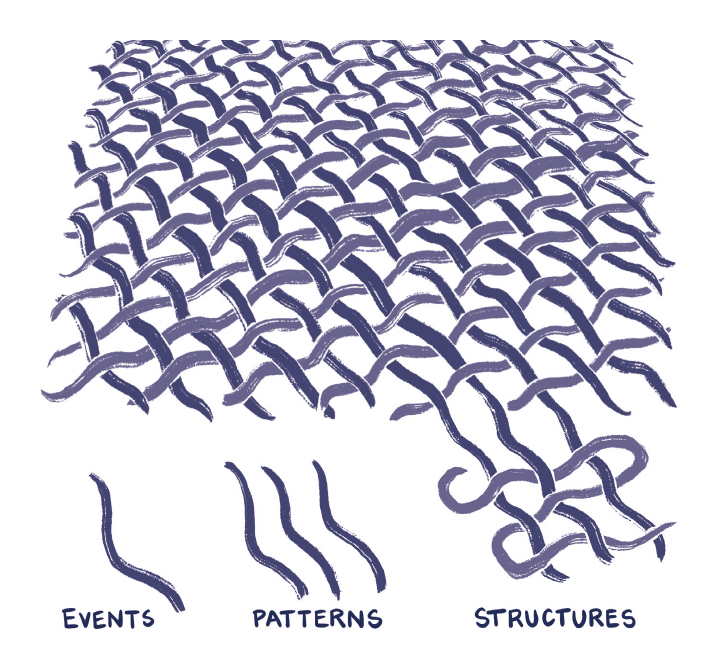
DYNAMICS FOR HOPE 8 DH 8: CREATING NEW EVENTS, PATTERNS, STRUCTURES AND NORMS
Now it’s your turn to create some events that bring people from very different backgrounds and positions into a new conversation. It might be possible to pattern these events and grow new habits regarding dealing with the themes of fairness, valuing difference and mutual respect; listening deeply to one another. These patterns might begin informing existing structures in your group or organisation and encourage them to examine whether they maintain separation or promote greater interdependence. Nurturing Hope is about developing new norms: through assisting future centred people and groups continually revisit their values, and explore their current assumptions about their role in a changing community and political context.liii
Shared Events, repeated, become Patterns. Patterns repeated over time then become new Structures. Once embedded, new Structures nurture and carry new social Norms about the ways we live together. This practical lensliv underpins the importance of promoting small changes as well as large institutional or societal changes. In conflict affected cultures and societies, dominant and opposed groups give little space to anyone within their traditions to ‘act differently’.
It is still important that those who can choose to act differently, find ways to do so. lv Too often, dominant groups close down cross-connecting initiatives because they are experiences that challenge and expose partisan positions. In both conflicted and secure societies, people finding new ways together, especially new connections that link those whom the dominant interests may wish to keep apart, can be a challenge to the status quo.
We are suggesting that people who wish their societies become more open, whether they are in small or large groups and organisations, need to carry this important knowledge with them. ‘Events, repeated, are important because they lead to patterns and, potentially, new structures and norms that nurture hope between people’ .
DH 8: EVENTS, PATTERNS, STRUCTURES AND NORMS.
INVITATION
We invite you to read two examples of people in different situations starting a new organisation. Please read the short stories and explore: How single events started a process. How the events repeated established a pattern of meeting and practice. How the patterns of meeting developed into more formal organisational structures. Once established, how the events, patterns, and the structure, became ways for new social norms about people to be carried and maintained into the future.
REFLECT ON YOUR OWN
Some People Who Established Women’s Aid Refuges and Support Services Events: Many years ago, in different countries, some women exercised their voices and established sheltered accommodation as refuges for women and children who were the objects of partner violence. Many of these early steps were marked by women responding to the silence around such ‘events’ of violence; some women taking the families into their own homes in the absence of accommodation being available.
Patterns: Once informal support groups became more widely known about, more and more women and children sought their support. Patterns of refuge practice often developed ‘on the hoof’ as women gathered in groups to look at what could be done in the immediate moment. Structures: Up till then, often violence against women was unacknowledged publicly, even though it existed.
As the floodgates opened and the stories of violence were publicly acknowledged and responded to, structures such as ‘Women’s Aid’ and other emergency accommodation structures were established as civil society responses, supported by charitable donations and, eventually, some state support. In addition, eventually new laws protecting women and children were secured.
These embryonic structures enabled lobbying and information about violence against women to be gathered, the law changed and public policy in support of women and children suffering partner violence to be lobbied for. Strong charitable law enabled independent and robust organisations to secure themselves and lobby strongly for further changes. Norms: Earlier silences were broken. Terrible judgemental assumptions that would have been prevalent many years ago, such as ‘women deserving their treatment!’
and ‘women making up stories’ were thrown out. Massive evidence
accumulated about a secret that had been hidden for many years. Assumptions about men being capable of violent and intimidating actions against their partners and children took hold in the public mind. Social norms about the dignity of women and children were established within the public square. Social norms about how vulnerable women and children could be supported and still make positive lives for themselves were generatedlvi.
The above synopsis identifies some of the stages women who initiated Women’s Aid type responses in diverse societies went through in their important journey. Over time, and sometimes very quickly, women came together as an event; met together regularly, establishing patterns to their meetings; these patterns of regular meetings enabled them to form civil society structures, action groups that, in time, became legal entities as charities responsible for multiple centres or refuges that gave sanctuary and support.
New societal norms were established. Creating Integrated Schools in Northern Ireland. Events: In Northern Ireland, in the midst of sectarian conflict, before and after 1974, a number of groups of parents and supporters came together from different urban and rural areas. They explored whether it was possible to create integrated schools in a society where almost all schools were understandably, and historically, linked to the opposed religious and political traditions.
Patterns: Meeting together on a regular basis they faced into many challenges, not least the challenge of being a so called ‘mixed tradition group’ in a society where such groups were very rare and where such groups often generated strong opposition. Many groups, looking back, speak of the challenges they had to be open to one another when heated topics around identity, religion and politics surfaced. However, when these groups look back, they respectfully and inclusively worked through these issues.
They became stronger together because of the regular meetings and open engagements. Structures: The first group, founded in 1974, established Lagan College in 1981, as a secondary school and others then followed. They were not initially funded by the public purse, so they secured their charitable status under the law.
With the help of enlightened philanthropic organisations, they managed to hold their course for the early years until the legislation changed and funding from central government was secured, along the same lines as all other schools. Norms: Formed in the midst of a conflict, their mere establishment and existence evidenced that shared institutions could be developed. A new social norm was established. It was possible for people from diverse and historically opposed traditions to work together in common purpose!
It was established in the wider public consciousness that it was possible for diverse people to establish a significant shared institution.
This new norm encouraged others in Northern Ireland who wished their children to be able to have their diverse traditions and cultures recognised. This movement from single events, to patterns, to structures and then new, shared norms supported many parents whose voices had not been acknowledged before this date.
Explore Your Reason
An Individual or Group Exercise
Now it is your turn to imagine and create some events that bring people from very different backgrounds and positions together into a new conversation Looking back to the beginning of these materials and the diagram, we invite you to think about moving free of any rivalries that restrict reason and choice and create a new space for hope to develop.
Decide whether you would be: A family member A colleague A team or organisation leader or You may have policy responsibilities in an organisation or in local or national government. Take time Take one ‘status’ from those above and imagine how you might develop an event about a theme or issue that would bring different people together in a new, more open and inclusive manner. Decide on your issue-it can be humorous or serious! e.g.
Mixed football; mixed hurling; a birthday party for all in the area whose birthdays fall in a particular time! Setting up a food bank; establishing a befriending service for the whole area, regardless of background and culture. Developing a singing group or band.
In a Role Play: Prepare your idea and then make your pitch to the group. Listen to all the suggestions and then jointly decide on what issue or theme you are going to work on further as a group.
Examine Your Choice
AS A GROUP Imagine: How will you develop an event? How will you get support to repeat and pattern this event on a regular basis? What structure might then evolve to promote this activity on a regular basis? How will your structure, in a small or large manner, stand for a more open society locally? Over time, what new norms do you hope to establish between people who previously shared little in common? How will your new group respond to those who will criticise your work?
Summary
Nurturing Hope, in part, is about standing together with others and creating new spaces to meet together, new initiatives or activities where people, previously ‘content’ to live apart, now want to do something new and together for the public good. It takes courage to break out of old separate ways. However all sorts of enjoyable and important groups and structures can develop once the break is made to move towards different others, rather than remain apart.