Conflict-Affected Cultures and Societies
DC 1 Opposed Identities Dominate - Relationships End
How opposed communal identities can displace equal citizenship and close down relationship.
Source: Nurturing Hope, Conflict-Affected Cultures and Societies, May 22 Final The Understanding Conflict Trust - Nurturing Hope - 4 Conflict Affected Cultures and Societies.pdf, pages 4-9
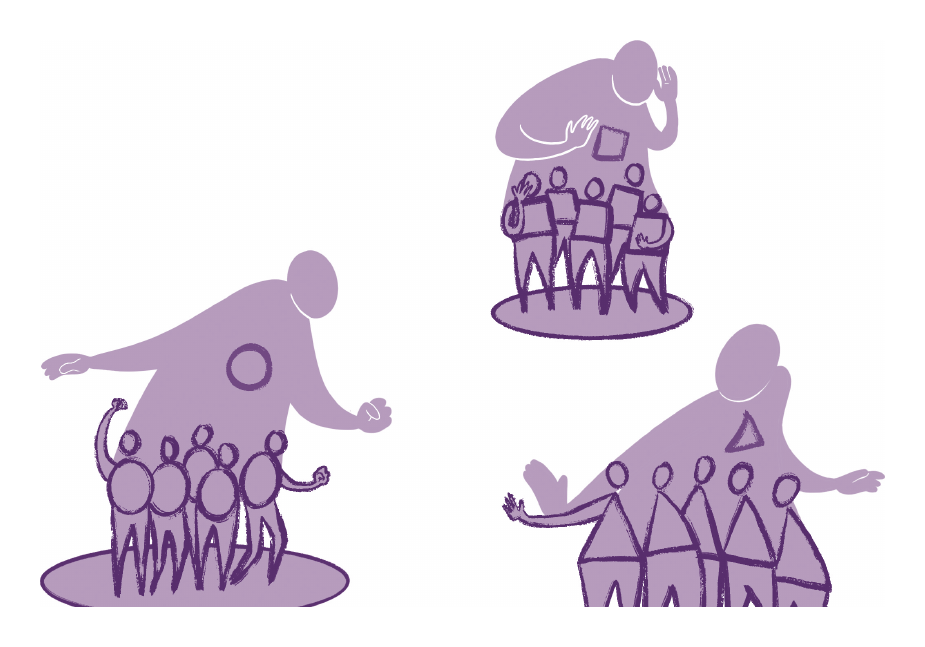
SOME DYNAMICS OF CONFLICT-AFFECTED CULTURES AND SOCIETIES 1 DC1: OPPOSED IDENTITIES DOMINATE - RELATIONSHIPS END
People in conflict-affected cultures and societies are unable to experience themselves as being equal citizens to others. More usually their different identities based on culture, interests, religion or other aspects become dominant. In conflict-affected societies the institutions of the state cannot count on all people giving them the same loyalty and support. In such societies, there are often very different levels of loyalty given to the criminal justice system. It is best, but not always possible, to (re)-establish the primacy of citizenship underpinned by agreed laws that guarantee individual rights and responsibilities.
In order to live more peacefully together, people in conflict-affected societies need people to come together across lines of difference. In such, often tentative, steps people find ways to move forward and not fall back into competing identity groups as their primary points of reference. With or without some wider political will, the civic need is to establish small transcending experiences within which different people consent to come together, such as family support groups, a social issue group or joint action.
Without such drives these societies become places where the relationship spaces for open, respectful and robust engagement close down. The absence of a joint action or an equal citizenship umbrella gives primacy to opposed communal identity groups. As opposed groups get stronger, they make it very difficult to establish an agreed, common, public culture and an agreed law and order system. Increasingly competing identities dominate the social landscape and public space.
When people do not experience being equal citizens, they give up some individuality for the sense of security that communal identity claims to give. Each competing tradition generates their own cultural umbrella based on the exclusion of the different others in their midst. In conflict-affected societies, opposed groups can generate justifications for discriminatory actions and violence. Historically, conflict-affected societies have been areas where major in-balances of power and access have existed.
All identity groups, when they have power, practice discrimination within systems where the writ of the law is partial and there is no commonly assented to criminal justice system. Addressing discriminatory practices is a central theme in peace agreements. Such agreements tend to move societies from a culture of identity politics to cultures of being equal citizens. Often, when enlightened majority leaders have moved to change, their followers have not supported them.
More often than not, when such changes are resisted, violence can follow.
On opposite sides of the fear and antagonismV line, members of each competing tradition have difficulty understanding the experiences and views of the other. A conflict-affected society has the capacity to create a circular dynamic from which it is difficult to break free. When opposed community identities become primary, separation-and even segregation-grows. It becomes very difficult to establish citizenship as the primary basis of a society in the face of cultural practices that exclude or deny different others.
Within conflict-affected societies, people from competing traditions give different levels of significance and loyalty to diverse public institutions. Many find it difficult to understand why those different to them feel so very differently. When communal identities dominate public spaces, the reality is that people primarily see one another as members of competing identities, not as different individual citizens.
Such societies, if they are to become more safe and secure for all, have to find ways to move away from the primacy of communal identity. Wrightvi looking at ethnic frontier societies argued all citizens needed: an agreed law and order system; no discrimination in public employment opportunities; control of education; freedom of cultural expression; and freedom of religious expression. Initially they may only be able to move together to face some external common threat or challenge.
However eventually, internally, they need to move to secure some commonly agreed political, justice and public structures where each person, regardless of their identity, has their place and where just and peaceful civic values are primary. Fair and equitable access to public employment and education needs to be secured. Acceptable and diverse cultural expressions by all need to be valued.
Under such a comprehensive rubric, a citizen-based society can grow again, one that is very different to one where daily life has been dominated by identity politics. For example, ardent majority tradition supporters of the police and court systems in one contested society often cannot understand those who do not trust the police and courts. Enthusiastic followers of one cultural tradition and its celebratory events often cannot understand how ‘others’ can be ambivalent or hostile to these same events.
The language people from different traditions use about the same thing can itself become politically and culturally loaded. For example, Unionists often speak of ‘the people of Northern Ireland” and Nationalists often speak of “all the people of Ireland” .
DC1: OPPOSED IDENTITIES DOMINATE- RELATIONSHIPS END
INVITATION
TO EXPLORE If you feel able to, please scribble some notes or write a longer diary type entry about how these experiences gave you confidence, or held you back, uncertain about being with different others?
REFLECT ON OUR OWN
If you are living in a conflict-affected society take time to reflect on the different aspects of your daily life that are impacted by the conflict or threat of conflict. OR If you are fortunate to live in a secure society imagine yourself to be living in a conflict-affected society you have read about. NOW For you, which groups or traditions are party to the conflict? Would you already be a member of one of these traditions or do you not identify with any group? How difficult is it, or might it be, to not align yourself with one of the competing traditions?
INVITATION
TO EXPLORE In real life or in a role-play sense: Were you or your family explicitly brought up within a specific political tradition? If so, can you name it? How did people from other political traditions view your political tradition? Were you and your family explicitly brought up within a specific religious tradition? If so, can you name it? How did people from other religious traditions view your tradition? Were you or your family explicitly brought up within a specific cultural tradition?
If so, can you name it? How did people from other cultural traditions view your tradition? Perhaps you do not feel you belong to a political, religious, and/or cultural identify? This is a choice many of us also exercise. If so, how have you been prepared to meet people from different political, religious, and/or cultural identities? What do you experience when meeting them?
Consider how different state institutions such as parliament, the police and the courts are viewed in both secure and conflicted societies. Staying with your own real life situation or in role: Looking back now, how did the culture of the different political, religious or cultural traditions impact on your views on:
-
The state you live in?
-
The policing and criminal justice system?
-
Being employed in the public service?
-
Your experience of education and the schools you attended?
-
Your freedom to go anywhere you would wish safely?
-
Your ease or unease in joining or supporting different sporting organisations, cultural and artistic groups? Have your views changed any over time? Now if you are in role, come out of role and be yourself. Consider your own life to date, in whatever society or societies you live in, or have lived in.
REFLECT ON YOUR OWN
Find Your Voice
Reflecting on your experience, would you describe yourself as a full citizen of the society in which you live, or not?
-
What examples would you bring as evidence?
-
What feelings are associated with these experiences? Reflecting on your experience, are there any times when you would prefer to describe yourself as a member of an identity group? If so:
-
What examples would you bring in support of this view?
-
What feelings are associated with these experiences?
-
How do others, different from you, view you in this situation?
Explore Your Reason
Consider a or b. a. If you have had experiences of being treated as a member of an identity group, not as an equal citizen, what reasons do those different to you have for treating you in this manner? Thinking more deeply: Is your wish to claim a political, religious or cultural identity driven by the fact that you do not experience having an equal place in your society? OR b. If you believe that you are a citizen of the society you live in, what do you value about being such a citizen? If you would describe yourself as a citizen, what do you think about those that say they do not feel full citizens? What experiences might lie behind them stating this point of view?
Examine Your Choice
For all: Do you wish to freely choose a specific political, religious or cultural identity? How easy or difficult would this be? Would others around you take you seriously? Is it important to you to be treated as an equal citizen? Yes or No?
COLLABORATIVE ACTIVITY
If you are willing now, speak about the themes above with another person or in the group of which you are part. Hearing your own voice and the voices of others, what are you now learning about the different experiences of being a citizen or not being an equal citizen? What are you now learning about the experience of being a citizen and having a shared community identity? How important is it for you to belong to an identity group?
Summary
Most people living in secure societies are relatively unaware of the importance of citizenship. Citizenship usually becomes an issue only when it is threatened or when people see or hear about people in other countries being prevented from exercising citizen-based rights. To be a citizen is about the significance of each individual person. It is about an individual’s freedom of expression and voice and it is central to belonging to a more open and democratic society.
When all share equal citizenship people can belong to diverse groups and identities. Such diverse groups, activities and experiences build the internal strength and diversity of the society. At the Nelson Mandela Annual Lecture 2014: Chilean President Michelle Bachelet paid tribute to Mandela, saying his life had been based on a “profound certainty that there are no differences that justify discrimination, violence, abuse or oppression. He had shown that the only viable path was one of cohesion and unity. ” Nelson Mandela Centre of Memory