Dynamics for Hope
DH 2 People Are Assets Not Problems
Our future, just as our past, depends on our relationships with others.
Source: Nurturing Hope, Dynamics for Hope, May 22 Final The Understanding Conflict Trust - Nurturing Hope - 5 Dynamics for Hope.pdf, pages 16-18
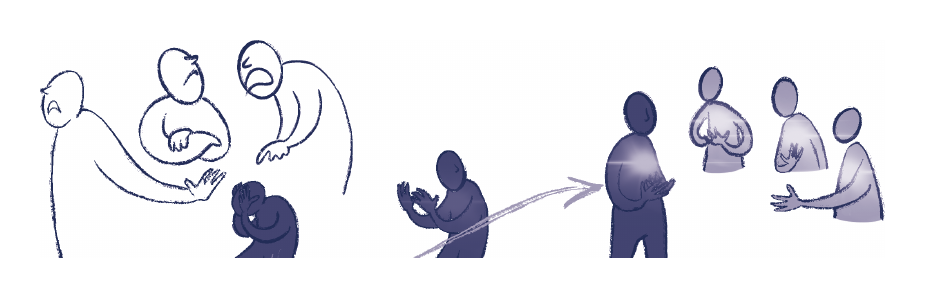
Our Future, Just As Our Past, Depends On Our Relationships With Others
“In our different histories… linguistic dehumanisation has often been followed by physical violence.”xix In Nazi Germany, Hitler portrayed the Jews as vermin and later six million people were killed. Metaphors can make the unreasonable seem reasonable, the illegitimate appear legitimate, and good people turn evil.
We need to always be vigilant, paying attention to the use of any words that diminish people. Such acts signal the de-humanisation of some fellow human beings!
We belong together: Our lives are interdependent with the lives of others.
Our future, just as our past, depends on our relationships with others.
The word scapegoat only appeared in the English language in the 1530’sxx. Its appearance came just as scapegoating, driving out different others unjustly, could no longer be hidden from viewxxi.
Bauman speaks of modern life being characterised by liquid relationships where relationships are temporary and people disposable. He argues that the development of an underclass culture occurs when people are deemed worthless.
For Bauman, this is the first time in modern culture where fellow feelings for the most vulnerable cannot be assumed as a civic value xxii.
We need to be attentive to our language and invite others to challenge us when we use excluding words in our daily language.
In real relationships, challenge is not a threat but an act of love.
Hope is nurtured when people develop and maintain a mental model that all are assets not problems. Such a belief is fundamental to whether children and young people live and move in relationships that affirm them.
When we reinforce cultures that rob people of their names, and isolate them with the language of being problems, we all lose our humanity and our possibilities to grow and develop together.
If we turn away from the challenge of seeing one another as gifts, we turn away from ‘living together in difference’ to ‘living apart indifferently’!
INVITATION
If you wish, please scribble some notes or write a diary note about your response to the stories below about people being assets not problems!
REFLECT ON YOUR OWN
There are small numbers of people who especially witness to a belief that all people are gifts.
The vision of the L’Arche Communities is that intellectually vulnerable people should live together in community with intellectually able people. The wider L’Arche Community commits itself to stand with intellectually vulnerable people throughout their entire life journey!
One story of the L’Arche Community in Belfast
The community established a regular meeting structure that was facilitated by one of the community with a severe disability. This new and bold step enabled a more open and gentle form of meeting and discussion and grew a new layer of sentiment between all. The depth of compassion and sensitivity fostered within that diverse group surpassed the experience of all involved earlier.
In this example what would have been your response if you had been a member of the staff group being facilitated by the most disabled person in the group?
Would you have slotted into this way of working easily?
Would it have challenged you? How?
A second story from a sheltered housing project for people with a disability:
A member of staff, being off work on bereavement leave, returned to the sheltered housing project and there was a meeting of the staff and the community members, who each had a learning disability.
At one moment, some staff members spoke out about work demands they thought the recently returned staff member needed to undertake urgently. There was a tense atmosphere, this was a breakdown in staff relationships.
Sitting in their midst was one of the community who was the most vulnerable in the room. Suddenly she spoke out saying, “Here, everyone, I think you should all be more attentive to this person’s situation. She has recently lost her mother!”
After a few awkward moments regrets were expressed, apologies offered and accepted. The room became a more human place through the intervention of the most vulnerable person in the room!
If you had been a member of the staff group in the Sheltered Housing Project when matters got tense, what would have been your response?
How would you have felt, when reminded of the person’s bereavement by the most vulnerable person in the room?
How do you think the staff member felt when harassed by her colleagues?
What courage did it take for the person who was the most disabled in the room to speak out?