Foundations
Foundations 2 The Origins of Nurturing Hope
The practical and historical origins of the Nurturing Hope materials.
Source: Nurturing Hope, Background Fundamentals, May 22 Final The Understanding Conflict Trust - Nurturing Hope - 1 Introduction.pdf, 6-13 Source notes
The Origins of Nurturing Hope
Northern Ireland And “The Troubles”
“ …no theory of justice today can ignore the whole world except our own country, and fail to take into account our pervasive neighbourhood in the world today, even if there are attempts to persuade us that it is only to our local neighbours we owe any help to overcome injustice…. There are few non-neighbours left in the world today”
Sen, 2009, p173
Some Background to the Northern Ireland Conflict
For the authors of this work, nurturing hope became an important theme living and working in Northern Ireland, a society in which division, conflict and violence were a daily part of politics for decades.
Often, many people were filled with hopelessness faced with the apparently endless stories of injury and killing, and the consequences of violence for their lives and the lives of their communities. Hope in this context was not only about a dream of better times in the future. Hope was also a lived experience, in which the possibility that a better future might be possible was given reality by glimpses of humanity and service in the present and in stories shared of experiences in the past.
Some Background to Northern Ireland
Northern Ireland came into existence in 1920 as a political solution by the British government to a deep political problem. Over many centuries, the island of Ireland had been a place of conflict as the British state expanded its political control, often violently. This experience of conquest shaped Irish identities, especially in experiences of brutal eviction from land or granting of land. Religious identities were often crucial factors deciding who was favoured and who was not. In general, Protestants who followed the established religion of the United Kingdom were seen as ‘loyal to the state’ and looked to the state to protect them against Catholic ‘rebels’. The majority Catholic population often experienced the state as hostile, as a source of violence and exclusion. These experiences shaped the stories of Protestants and Catholics and their identities, their economic lives, their cultural experiences, and their politics. As democracy spread, most Catholics began to demand an independent Ireland. Freedom meant liberation from Britain. Justice was associated with reversing the humiliations and injustices of conquest and peace and was the harvest of freedom and justice, even if it was won with violence. Most Protestants, living mostly in the Northeast of the island, saw the state as a way to protect their freedom from Catholic Church domination.
By the time of World War One, these ideas had led to the emergence of armed groups, determined to defend or win their cause. British proposals for Irish Home Rule (self-government) were opposed by armed Protestants determined to stay in the British Empire. In response, some Irish nationalists, dedicated to a republic and therefore called ‘republicans,’ also armed. During the war they staged an uprising at Easter 1916. Although it failed, they became heroes when the leaders were executed as criminals by the British government.
In this armed and dangerous context, after the War the British government was faced with stronger demands for independence for Ireland. As violence escalated, the British government accepted that Home Rule, or even independence, was crucial. But in areas where Protestants were in a majority or a large minority, the Protestants were also determined to resist any effort to break ‘the Union’ with Britain. In an effort to solve their political problem, the British decided to draw a line, dividing Ireland in two: A Northern part with a protestant majority and a large catholic minority which stayed inside the UK and the rest, eventually known as the Irish Free State, where the population was over 90% Catholic.
While the Free State developed into a Republic and settled down as a stable, Catholic, quite poor, new country, division inside Northern Ireland dominated from the beginning. The Unionist majority (mostly Protestant) accepted the new system and had a monopoly on the government of the region. Politically they organized to protect themselves against the perceived threat, including their Catholic neighbours. Catholics, overwhelmingly still Irish Nationalists, both resisted the new state and felt excluded by it and discriminated against.
Violence was never far from the surface, although there were long periods when it was nurtured in stories and rituals rather than in real life. Almost every aspect of life was affected by division between Unionists and Nationalists, Catholics and Protestants including where people lived, where they went to school, cultural, economic and social expectations. In the 1960s, tensions around Catholic exclusion and discrimination exploded in political disputes over civil rights. Control of the state, and the existence of Northern Ireland itself were at stake. Confrontation between the Unionist government and Civil Rights protesters escalated and the British Army became a part of the daily life of Northern Ireland. In many Catholic areas they were seen as occupiers, although others saw them as a crucial part of the defence of law and order.
For almost thirty years, violence between groups rooted in different communities, and involving the whole system including the government, dominated public life. People living in the midst of the turmoil responded in different ways. At times, some supported or sympathised with violence in pursuit of their cause. At other times, many were in despair about the daily carnage and damage being done by the conflict. Some lived in areas where violence was immediate and close and persistent. Others tried to find refuge in areas and activities where violence was more distant. Everybody, however, had to make their way in the midst of violence which dominated and shaped daily life and political debate.
We learned that we were in the midst of violence, sometimes as victims and sometimes as participants, and often as bystanders and onlookers. We needed to be with others, nurturing hope in the small yet significant actions of people coming together and working together for a future beyond distrust, fear and violence.
Essentially ‘Nurturing Hope’ emerges from a refusal to give in to a fascination with violence and destructive actions that, for many people, led them, too readily, into losing hope in Northern Ireland during the recent conflict there. Historically ‘Nurturing Hope’ belongs to:
Ecumenical Action-Pre World War 2 and post 1945 in Europe
There was a strand of ecumenical practice in the 1930’s that challenged the rise of fascism and which later, post 1945, informed the wider ecumenical movement in Europe and beyond.
This slender ‘hope-filled’ strand of practice continued in Northern Ireland through people such as Ray Davey, a three-year Prisoner of War who: witnessed the Dresden bombings; on his release then established home stays for students from Northern Ireland and Germany; and in 1965, formed the Corrymeela Community of reconciliation in Northern Ireland.
In this task Ray and Kathleen Davey also drew on the inspiration of their neighbour and friend, Helen Lewis, an Auschwitz survivor who came to live in Belfast and worked across the city teaching dance and being an advocate for reconciliation.
The Corrymeela Community of Reconciliation in Northern Ireland, 1965-present
Nurturing Hope emerges primarily from diverse reconciliation practices in Northern Ireland from 1965 onwards. Initially these grew out of the civil society activities of The Corrymeela Community of reconciliation in convening cross-community dialogues with diverse faith traditions, social issue groups, and political groups.
From 1966 this practice supported the growth of residential opportunities for young people attending schools and youth clubs in areas dominated by poverty and sectarianism. Such work was transformative education.
With the emergence of the Civil Rights Campaign and the civil conflict from 1968, Corrrymeela initiated and supported a number of cross tradition dialogues about community relations practices, policing, models of political co-operation, inter-church, inter-faith and intercultural meetings.
Corrymeela also initiated numerous cross-community residential educational practices linking the need to address sectarianism, poverty and under-achievement, becoming a partner in John Malone’s first Schools’ Community Relations Project, 1970-73 vi.
Additionally the work of Corrymeela addressed: the needs of victims and survivors, some of whom were members of Corrymeela; the needs of long-term political prisoners and their families; the needs of people in mixed marriages and mixed relationships with the formation of NIMMA; and, later, the rights of people involved in LGBTQX relationships; and working with the Red Cross on the needs of newcomer families seeking more secure lives away from other areas of ethnic conflict in the world.
These were part of Corrymeela supporting a growing civil society base of cross-tradition family work, support to emerging community organisations and cross-tradition dialogues about community relations, policing, and politics.
Reconciliation Practice in Ireland and Britain
There were many courageous people and groups from diverse faith, social, and cultural backgrounds, who came to spend time at the Corrymeela residential centre and who refused to give up hope in the face of having their family members being threatened, intimidated, killed or injured.
Others such as Peter Tennant and Sydney Bailey became supporters of Corrymeela, having been members of the Friends Ambulance Unit in the Sino-Japanese War (1937-45). Peter, an experienced forester, at 66 years of age came to live near Corrymeela from 1978 and planted the trees at the Centre as well as drafted papers for the Committee on the Administration of Justice. Sydney had been a UN Mediator.
The actions of people in Ireland (mainly through links to the Glencree Community) and Britain (mainly through the Iona Community, the Coventry Cathedral Reconciliation Programme and St. Ethelburga’s, London), brought people and groups from diverse faith, social, and cultural backgrounds to spend time at the Corrymeela residential centre and apply their learning locally and nationally to this reconciliation practice.
Initial work bringing people from Northern Ireland together to Holland undertaken by the Dutch Northern Ireland Committee had several Corrymeela Community members as part of this committee, David Stevens, Louis Boyle and Colin Murphy. The new forms of learning associated with that programme, developed mainly by Aat van Rhijn, Andris Lascaris and Roel Kaptein were then, from 1979 onwards, incorporated into the learning practices of Corrymeela Members, Volunteers and Programme Staff through the initiative of the members mentioned earlier and John Morrow, Leader of the Corrymeela Community (1980-93) and Derick Wilson, the Corrymeela Centre Director (1978-85).
Practical experiences and theoretical perspectives on Reconciliation
‘Nurturing Hope’ evolved through ‘Understanding Conflict…’ and ‘Future Ways’, a seventeen-year programme of social and public policy research and organisational practice promoting a more open, shared and just society, supported by the Understanding Conflict Trust (Ulster University, 1989-2006) and emerging from the Corrymeela Community.
Theoretically ‘Nurturing Hope’ draws heavily on the extensive work of Dr. Roel Kaptein with the writings of (the late) Rene Girard, Stanford University, a member of The Academie Francaise. Roel was an early collaborator with Girard in establishing the Colloquim on Violence and Religion (COVR)Vii and spent many days every year from 1979-95 at The Corrymeela Centre facilitating reflective learning groups on the ideas of Rene Girard. Roel became a member of the Corrymeela Community.
This practice continued through week long, weekend and evening reflective learning sessions and was pivotal to supporting a group of around 100 people explore the practical outworking of Girard’s work within all aspects of life in Northern Ireland and in their daily family, professional and civic involvements.
Additionally, these Girardian insights were brought into the teaching of politics and political history through the late Frank Wright (Queens University; University of Limerick) and Duncan Morrowviii and into community relations, reconciliation and restorative practices by Derick Wilsonviii (Ulster University) through the Understanding Conflict Trust.
A number of working texts were prepared over the years by Roel Kapteinix and two books were published.
René Girard’s ‘mimetic theory’ of human culture and social order has, for some, the power to model and explain violent sacralities, ancient and modern. Its insights have been practically applied: from Crusade and pogrom to Dreyfus and the Holocaust; from gospel apocalyptic and environmental crisis to the religious wars, suicide bombers and culture clashes of our fast-globalising world. (Girard Colloquim, June 2011)
In the life of Corrymeela, from 1979 until 2007 especially, the mimetic lenses Girard opened up on: biblical texts that illuminated how we deny our rivalry and violence; perspectives that challenged the old certainties of religious and political understandings, rooted in crucifixion and victimisation denied; and the invitation, in humility and vulnerability, to follow ways of contrast, inclusion and communion with different others became fundamental. These understandings informed the experience of many Corrymeela members and friends in seeking to be true to the task of healing and reconciliation.
These were understandings brought to us, not by people who were primarily academics or theologians but, by people who had: stared into death at war, such as Ray and Helen; who had protected and sheltered Jewish people being pursued in WWII such as Roel, Aat and Andre; who had seen members of the gay and romany communities isolated; who had experienced the ecumenical challenge to build a new united Europe after the horrors of a Europe at war (over 8.5 million dead and 21.5 million casualties in WW1: 60-72 million in WW2 according to some estimates); and who had sought to be ecumenical in a climate of increasing sectarian theology locally such as Ray Davey, Carrie Barkley, John Morrow, Craig Cameron, Desney Cromey, Bill Boyd, William Rutherford, Conor Bradley, Diana Carson, Trevor Williams, David Stevens and many more.
Many of the Dutch and German practitioners were central to establishing the Church and Society ecumenical education centres throughout Europe, of which Corrymeela became a part. That some then became academics and theologians was important as they struggled to find ways of understanding what they had lived through without being defeated by it; and as they sought to develop frameworks of belief and understanding that enabled and ennobled citizens to live hopefully, and faithfully, in and beyond so much hopelessness.
Rene Girard and Mimesis-Living secured through scapegoating or through living well together!
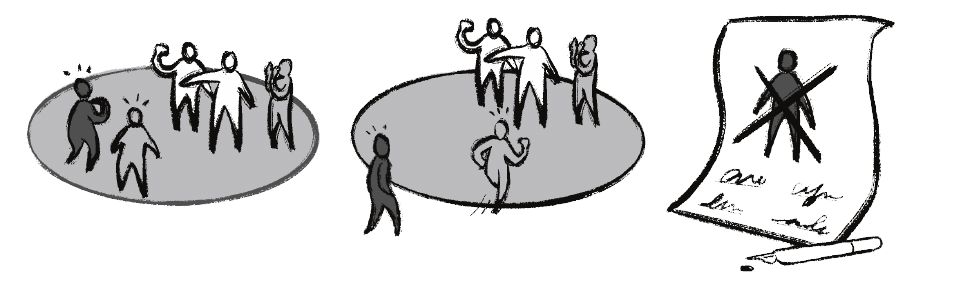
For Girard mimetic desire operates as a subconscious imitation of another’s desire. The same unconscious pull explains both friendship and rivalry. As rivals become more and more fascinated with each other, friends and colleagues may be mimetically drawn into the conflict as rival coalitions form. What began as a personal battle may escalate into a battle of ‘all against all’, threatening the cohesion and peace of an entire community. One way of solving this problem is to find someone to blame for the conflict that all the rival coalitions can unite against-a scapegoat. This unfortunate person may or may not be guilty. All that is required for the scapegoating solution to work is that their guilt is universally agreed upon and that when they are punished or expelled from the community, they will not be able to retaliate. The proof of their guilt is found in the peace that now returns to the community, obtained by virtue of the unanimity against the scapegoat. Mimetic theory allows us to see that the peace thus produced is violent, comes at the expense of a victim, and is built upon lies about the guilt of the victim and the assertion of innocence by the ‘remaining community’. For Girard this mechanism functioned at the origins of the human species. We were introduced to the work of Girard and his lenses on: experiences of being bound to the cultural ways of rivalry and violence; and particular lenses on biblical texts that unveiled, rather than denied, such waysx.
Over many years we explored in our own lives, and in wider organisational, societal, economic, educational, family and political life, the ways associated with unrelenting rivalry and, in contrast, our potential to model ways about living and working in more just relationships and structures that give one another dignity, freedom and space. In these materials the mimetic hypothesis underpins our educational work. The materials invite us to examine whether, especially in open and trusting relationships with different others, we can live in ways that relationally and structurally model freedom and trust with one another. Such ways are free of destructive rivalries with perfection, self generated impossible standards, and real and imagined expectations others have of us. In these materials we will explore the extent to which cultures still are bound up in: hiding scapegoating and denying victimage; the generation of the good and the bad; the righteous and the unrighteous; the denying of how we hurt others, individually and collectively; and, in terms of nurturing hope, the possibility for each of us to take responsibility to live in more open, just, robust and challenging ways, one with another.
In the life of Corrymeela these lenses have enabled ethnocentric, racist, sexist and sectarian behaviours to be understood more and unveiled. They have enabled some shared robust spaces to be generated as we all sought and seek to understand the positions many of us can take in political, civic and religious life. It has, as often as not, been an internal and personal journey together, as a community of people from diverse backgrounds, as well as a wider reflective task with others. The major challenge was, and still is, to find human relationships and structures with different others in which sentiment, attachment, understanding and unexpected openness might evolve.
Parallel Reconciliation Movements and Initiatives-Korea, Japan, USA
More recently this practice has found resonance with other civil society partners: from: Korea through the Okedongmu Children’s Project, a leading NGO involved in Korean peninsula practices; Waseda University, Japan; and with community education practitioners in the United States and teaching staff associated with St Philip’s College and North West Vista College, San Antonio (Alamo Colleges District) through the links made possible by a Fulbright Scholar-in- Residence position from 2019-2020.
Nurturing Hope-Dissolving Distrust and Rivalry-Fear and Conflict
These lenses on rivalry and conflict and ways of creating more open relationships and structures then inform us, and many others, in our day-to-day lives and, for many, in our work and in our faith lives. They have been applied in our individual lives; in work with vulnerable young people; in support for victims and survivors; in work with those who have acted violently; in meetings between police, politicians, trade union members, business people, public service officials and members of civic and religious groups; in understanding politics; and in economics too. At this time, locally, we have, hopefully, moved away from being dominated by movements on all sides that readily contemplate violent revenge and death as first steps, yet we have been near that point at different times. In other parts of the world currently these movements are also strong.
If part of our human origin is that many of the cultures we have drawn from have been secured by their foundation violence being denied; If, as in the conflictual history between Britain and Ireland, it takes so much time to agree a place and time where this violent history is unmasked and acknowledged; If the eventual healing rituals of the Queen and the President of Ireland meeting together took so long to agree and establish; If part of our human story is that we are less willing to acknowledge the violence underpinning many of the cultural benefits we, who are well to do or Western, live off; If a reality in daily life for many now is that groups and societies have less holding them back from doing violence to another: If, as we face the challenge of working interdependently to address the challenge of rapacious activities that are threatening global sustainability; are we able to model new ways of living inclusively, one with another, across lines of social, political, cultural and faith differences? The lenses of rivalry and the obstacles of perfection and standards we set; the denial of our violence, especially our capacity to deny our tendency to victimise and scapegoat; are all ways that diminish us as human beings. At the same time there are other lenses: of freedom; an openness to the ability of meeting and trust to dissolve fear and despair; of communion one with an unexpected other; that we can embrace and move forward with, even if in a halting or broken manner. It is to these lenses that we turn to these materials.
“ If you are free, set someone else free” Toni Morrison